Sign in
Home
LNP Formulation and Screening Glossary
By Joshua Gomes
A categorized glossary of terms used across LNP formulation screening, from lipid components and mixing to characterization and data quality.
LNP components and cargo
A lipid nanoparticle (LNP) is assembled from a small set of lipid components that package, protect, and deliver a nucleic acid cargo. These terms cover the lipids most often used in RNA-LNPs and the cargos they carry.
| Term | Definition |
|---|---|
| ALC-0315 | An ionizable lipid used in an approved mRNA COVID-19 vaccine and a common benchmark when teams screen new ionizable lipids. Like other ionizable lipids, it carries a positive charge at acidic pH to bind RNA during mixing and becomes close to neutral at physiological pH. |
| Cationic lipid | A lipid with a permanent positive charge, such as DOTAP or DDAB, that binds nucleic acids through electrostatic attraction. Cationic lipids form stable complexes with cargo but stay charged at physiological pH, which is one reason many RNA formulations use ionizable lipids instead. |
| Cholesterol | A sterol that fills the gaps between the other lipids in an LNP, adding rigidity and stability to the particle. It typically makes up around 40 mol% of the lipid composition in common RNA formulations. |
| DLin-MC3-DMA | An ionizable lipid, often shortened to MC3, used in the first approved siRNA-LNP therapeutic. It remains a widely used reference lipid in LNP screens and published comparisons. |
| DSPC | Distearoylphosphatidylcholine, a saturated phospholipid used as the helper lipid in several approved LNP products. It supports the structure of the particle and typically makes up about 10 mol% of the lipid composition. |
| Helper lipid | A lipid, usually a phospholipid such as DSPC or DOPE, that supports the structure and stability of the LNP alongside the ionizable lipid, cholesterol, and PEG-lipid. The choice of helper lipid can also influence how efficiently the particle releases its cargo inside the cell. |
| Ionizable lipid | The lipid primarily responsible for encapsulating and delivering RNA in an LNP. It becomes positively charged in the acidic buffer used during formulation, which lets it bind the RNA, and returns to near neutral at physiological pH. Ionizable lipids are the component teams vary most often in LNP formulation screening. |
| Lipid nanoparticle (LNP) | A nanoparticle built from lipid components that encapsulates a nucleic acid cargo, protects it from degradation, and delivers it into cells. Most RNA-LNPs combine an ionizable lipid, a helper lipid, cholesterol, and a PEG-lipid, and they are typically under about 100 nm in diameter. |
| mRNA | Messenger RNA, a single-stranded RNA that carries the instructions for making a protein. Once an LNP delivers it into the cytoplasm, the cell translates the mRNA into the encoded protein, which makes mRNA the most common cargo in vaccine and protein replacement programs. |
| Nucleic acid cargo | The genetic payload an LNP is designed to carry, such as mRNA, siRNA, self-amplifying RNA, or plasmid DNA. The cargo’s type and size influence choices such as N/P ratio and lipid composition, and the amount used per formulation sets how far a cargo lot stretches across a screen. |
| PEG-lipid | A lipid attached to a polyethylene glycol chain, such as DMG-PEG 2000, that sits on the particle surface. Although it typically makes up only about 1.5 mol% of the formulation, the PEG-lipid has a strong effect on particle size, limits aggregation, and improves storage stability. |
| Phospholipid | A lipid with a phosphate-containing head group and two fatty acid tails, the same class of molecule that forms cell membranes. In LNPs, phospholipids such as DSPC serve as helper lipids. |
| Plasmid DNA | A circular, double-stranded DNA molecule that encodes a gene of interest. Plasmid DNA is larger than most RNA cargos and must reach the cell nucleus to be expressed, which makes it a more demanding cargo for LNP delivery. |
| Self-amplifying RNA (saRNA) | An RNA that encodes both a protein of interest and the replication machinery to copy itself inside the cell, which can produce more protein from a smaller dose. saRNA molecules are several times longer than conventional mRNA, which can affect encapsulation and particle size. |
| siRNA | Small interfering RNA, a short double-stranded RNA of about 21 base pairs that silences a target gene by triggering degradation of that gene’s mRNA. siRNA was the cargo in the first approved LNP therapeutic. |
| SM-102 | An ionizable lipid used in an approved mRNA COVID-19 vaccine and a common reference lipid in LNP screening. Blank SM-102 LNPs are the basis of the published performance data for the LNP Screening Array. |
Formulation design
Formulation design defines what each formulation in a screen contains and how the screen is organized. These terms cover lipid composition, buffers, and the way screening rounds are planned and tracked.
| Term | Definition |
|---|---|
| Acetate buffer | A sodium acetate buffer, typically between pH 4 and 5, commonly used for the aqueous phase during formulation. The acidic pH gives the ionizable lipid a positive charge so it can bind the RNA as particles form. |
| Aqueous phase | The water-based solution in an LNP formulation, containing the nucleic acid cargo in an acidic buffer. It is mixed with the organic phase, most often at three parts aqueous to one part organic. |
| Buffer pH | The pH of the aqueous buffer during and after formulation. Formulation typically runs at about pH 4 so the ionizable lipid is charged, and processing then raises the pH to about 7.4 for storage and testing. |
| Citrate buffer | A sodium citrate buffer, usually between pH 3 and 4, and one of the most common aqueous buffers for RNA-LNP formulation. Its concentration and pH both influence encapsulation and particle size. |
| Design of experiments (DoE) | A statistical approach that varies several factors together, such as molar ratios and N/P ratio, to map how they interact with fewer formulations than testing one factor at a time. DoE screens depend on consistent mixing so that each result reflects the factors being varied. |
| Formulation | A single LNP sample defined by its lipid composition, molar ratios, cargo, buffer, and mixing parameters. In a screen, each formulation is one candidate that is made, characterized, and compared against the others. |
| Formulation library | The full set of formulations made and tested in a screen, usually built by varying lipids, molar ratios, N/P ratio, or cargo across a plate map. How much of a library fits into one round depends on screening throughput. |
| Hit | A formulation that meets a screen’s criteria for size, PDI, encapsulation, or in vitro performance and earns a place in the next round. Hits are selected by comparing formulations across those readouts. |
| Lead formulation | The formulation selected after one or more screening rounds as the strongest candidate for further studies. A lead is chosen on the combined strength of its physicochemical and in vitro data, confirmed with replicates. |
| Lipid library | A collection of candidate lipids, most often ionizable lipids, screened to find those that encapsulate and deliver a given cargo best. On-deck formulation brings more of a library into each screening round. |
| Lipid mix | The combined lipid components of a formulation, dissolved in ethanol at a defined molar ratio. The lipid mix forms the organic phase that meets the aqueous phase during mixing. |
| Lipid stock | A concentrated solution of a single lipid in ethanol, used to prepare lipid mixes. Many screening methods blend lipid stocks into lipid mixes on the liquid handler. |
| Lipid-to-RNA weight ratio | The mass of total lipid divided by the mass of RNA in a formulation. It is an alternative to N/P ratio for describing how much lipid is available to encapsulate the cargo. |
| Molar ratio | The proportion of each lipid component in a formulation, expressed in mol%. A common starting point for RNA-LNPs is about 50
|
| N/P ratio | The ratio of amine nitrogen atoms on the ionizable lipid to phosphate groups on the nucleic acid cargo. It describes how much positive charge is available to bind the cargo, and RNA formulations commonly fall between about 3 and 6. |
| Organic phase | The lipid mix dissolved in ethanol. When it meets the aqueous phase during mixing, the ethanol is diluted and the lipids assemble into particles around the cargo. |
| Plate map | The layout that assigns each formulation, reagent, and replicate to a well or deck position. A consistent plate map keeps formulation, characterization, and in vitro data traceable to the same sample and helps keep screening consistent across teams. |
| Screening round | One pass through a screen, from designing a set of formulations through formulation, characterization, in vitro testing, and selection. Results from each round shape the design of the next. |
Mixing and particle formation
LNPs form the moment the lipid and aqueous phases meet, and the mixing method largely determines the particles that result. These terms describe how particles form and the methods used to mix the two phases.
| Term | Definition |
|---|---|
| Flow rate ratio (FRR) | The ratio of aqueous phase flow to organic phase flow during microfluidic mixing, most often 3
|
| Hand mixing | Combining the lipid and aqueous phases by pipetting them together manually. Hand mixing is quick to set up and common in labs without a formulation instrument, but it gives little control over mixing speed, which tends to produce larger and more variable particles. |
| Impinging jet mixing (IJM) | A turbulent mixing method in which high-velocity lipid and aqueous streams collide head-on in a small chamber. IJM runs on dedicated pump-driven instruments such as the KNAUER NanoScaler. |
| Laminar flow | Smooth, layered flow in which fluid streams travel side by side with little turbulence, as in most microfluidic channels. Because laminar streams mix mainly by diffusion, microfluidic mixers use channel features to bring the streams together quickly. |
| Microfluidic mixing | Mixing the lipid and aqueous phases as they flow through micrometer-scale channels at controlled flow rates. Because every volume of fluid mixes the same way, microfluidic mixing produces small, uniform LNPs. The LNP Screening Array brings microfluidic mixing onto the liquid handler deck. |
| Mixing time | The time it takes the lipid and aqueous phases to reach a uniform composition. LNPs begin forming within milliseconds, so a mixing time shorter than particle assembly produces smaller, more uniform particles. |
| Nanoprecipitation | The process behind LNP formation, in which lipids dissolved in ethanol lose solubility as the ethanol is diluted with water and precipitate as nanoparticles. The speed and uniformity of that dilution shape the particles that form. |
| Pipette mixing | Formulating LNPs by combining the lipid and aqueous phases in a well and mixing them through repeated aspirate and dispense cycles, by hand or on a liquid handler. Results vary with tip type, mixing speed, cycle count, and volume, and pipette-mixed particles run larger and less uniform than particles made with microfluidic mixing. |
| Rapid mixing | Mixing that brings the lipid and aqueous phases to a uniform composition faster than particles assemble. Rapid mixing is the basis of controlled LNP formation in both microfluidic and turbulent mixers. |
| Self-assembly | The spontaneous organization of lipids and nucleic acid cargo into particles as the ethanol in the organic phase is diluted. Because nothing external shapes the particles, the mixing environment largely determines their size and uniformity. |
| T-junction mixing | A simple mixing geometry in which the lipid and aqueous streams meet at a T-shaped channel junction. T-junctions are easy to build but mix more slowly than mixers designed to fold the streams together. |
| Total flow rate (TFR) | The combined flow rate of the aqueous and organic phases through a mixer. Higher TFR generally speeds mixing and produces smaller particles, and on the LNP Screening Array, TFR is set in the automation protocol. |
| Turbulent mixing | Mixing driven by chaotic, high-velocity flow, as in impinging jet and vortex mixers. Turbulent mixers typically run on dedicated pumps and instruments. |
| Vortex mixing | Mixing the lipid and aqueous phases by agitating a tube on a laboratory vortexer, a quick method that offers limited control over particle size. In formulation literature, the term can also refer to multi-inlet vortex mixers, a turbulent mixing design. |
Formulation equipment and automation
Formulation can run on a dedicated instrument, a pump- or pressure-driven setup, or the liquid handler itself. These terms cover the equipment, labware, and automation concepts that shape how formulation fits into a screen.
| Term | Definition |
|---|---|
| Air-displacement pipetting | The most common pipetting technology, in which a piston moves a cushion of air that draws liquid into or pushes it out of the tip. Liquid handlers such as the Hamilton STAR and Opentrons Flex use air-displacement pipetting, and our automation protocols account for how these systems deliver liquid when they drive the LNP Screening Array. |
| Benchtop formulation instrument | A standalone instrument that formulates LNPs outside the liquid handler, such as the NanoAssemblr Ignite or Unchained Labs Sunscreen. These instruments add bench space, separate software, and manual sample transfers to a screen. Other examples include the PreciGenome NanoGenerator, TAMARA, and the Dolomite Automated Nanoparticle System. |
| Carryover | Residual material from one formulation that remains in a mixer or fluid path and enters the next formulation. Reusable mixers rely on cleaning and validation to control it, while a new micromixer for every formulation avoids it. |
| Cartridge | An enclosed microfluidic mixer loaded into a benchtop formulation instrument for each run. Cartridge-based instruments such as the Cytiva NanoAssemblr require an operator to load inputs, start the run, and recover the sample by hand. |
| Collection plate | A microplate that receives formulated samples for processing and characterization. Collecting samples into a plate on deck lets the liquid handler continue directly into dilution and assay preparation. |
| Consumable | A component that is used and then replaced, such as pipette tips, plates, or microfluidic chips. The LNP Screening Array is a consumable with a new micromixer for every formulation, and consumables are a major factor in the cost per LNP formulation. |
| Dead volume | Liquid that stays in tubing, channels, or wells and never reaches the collected sample. Dead volume matters most when RNA or new lipids are scarce, and the LNP Screening Array keeps it below 50 µL per formulation. |
| Deck | The working surface of a liquid handler where plates, tips, reservoirs, and consumables sit during a run. |
| Deck adapter | A fixture that holds a piece of labware at the correct position and height within a deck position so the liquid handler can access it reliably. |
| Deck position | A defined location on the liquid handler deck, typically sized for one SLAS-format plate. Deck planning assigns reagents, tips, consumables, and collection labware to positions before a run, and the free positions determine how much LNP screening equipment fits into one method. |
| Labware | The plates, tubes, reservoirs, and tip racks a liquid handler uses during a method. Labware definitions give the liquid handler each item’s dimensions so it can pipette accurately. |
| Liquid handler | An automated pipetting system that transfers precise volumes between labware on its deck. Liquid handlers can automate reagent preparation, dilution, and assay setup, and with the LNP Screening Array, the same instrument runs automated LNP formulation. |
| Liquid handler method | The programmed sequence of steps a liquid handler runs, including aspirating, dispensing, mixing, and moving labware. Formulation on the LNP Screening Array runs as part of this method, so a team can run microfluidic formulation without a microfluidics engineer. |
| Microfluidic chip | A device with micrometer-scale channels that mixes or handles small volumes of liquid. Chips for LNP formulation are usually connected to pumps or pressure controllers through tubing. |
| Pipette tip | The disposable tip that holds liquid during aspiration and dispensing on a pipette or liquid handler. On the LNP Screening Array, standard pipette tips seal to each micromixer to drive formulation. |
| Positive-displacement pipetting | A pipetting technology in which a piston contacts the liquid directly, with no air cushion in between, so viscous and volatile liquids such as ethanolic lipid mixes are delivered accurately. The Formulatrix FLO i8 PD uses positive-displacement pipetting, and the LNP Screening Array runs on it with a configured automation protocol. |
| Pressure controller | An instrument that pushes liquid through a microfluidic chip by pressurizing sealed reservoirs. Pressure-driven formulation setups add a controller, reservoirs, tubing, and software to the lab, although microfluidic formulation does not require a pressure controller. |
| Pressure-controlled pipetting | A pipetting technology that aspirates and dispenses with regulated vacuum and positive pressure, using a sensor in each channel to measure the volume of liquid as it moves. The Dynamic Devices Lynx uses this approach in its Volume Verified Pipetting (VVP) heads, and our automation protocols support it on the LNP Screening Array. |
| Priming | Filling tubing and channels with liquid before a run so flow is stable once formulation begins. Priming consumes reagent that never reaches a sample. |
| Reagent plate | A plate holding the reagents a liquid handler draws from during a method, such as lipid mixes and RNA solutions. |
| Reusable chip | A microfluidic chip used for many formulations, with cleaning and performance checks between runs. |
| SLAS microplate footprint | The standard outer dimensions for microplates, 127.76 by 85.48 mm, defined by SLAS and ANSI. Labware built to this footprint fits standard deck positions on most liquid handlers. |
| Syringe pump | A pump that advances loaded syringes at a set rate to drive liquid through a microfluidic chip. Syringe pumps must be loaded and primed for each run. |
| Walk-away run | A run in which the liquid handler carries out the method without operator intervention. |
Processing after formulation
Freshly formed LNPs sit in an acidic, ethanol-containing buffer that is not suitable for storage or cell-based assays. Processing moves them into a stable storage buffer and prepares them for measurement.
| Term | Definition |
|---|---|
| Buffer exchange | Replacing the acidic, ethanol-containing formulation buffer with a neutral storage buffer such as PBS. Buffer exchange is usually the first step after formulation and is done by dialysis, desalting columns, centrifugal filtration, or tangential flow filtration. |
| Centrifugal filtration | Using a spin filter with a defined molecular weight cutoff to concentrate LNPs or exchange their buffer in a centrifuge. It suits small screening volumes and many samples at once. |
| Concentration | Increasing the amount of nucleic acid per unit volume in a formulation, usually by centrifugal or tangential flow filtration, to reach the dose needed for downstream assays. |
| Desalting column | A size-exclusion column that separates LNPs from small molecules such as ethanol and buffer salts, giving fast buffer exchange for small volumes. |
| Dialysis | Buffer exchange through a semipermeable membrane, with the sample held against a large volume of storage buffer for several hours. Dialysis is gentle but slow. |
| Dilution | Adding buffer to a formulation to lower its ethanol content after mixing or to bring a sample into the working range of an assay such as DLS. Dilution for DLS is often automated on the liquid handler. |
| Ethanol removal | Lowering the ethanol left in a formulation after mixing, since residual ethanol can destabilize particles and interfere with cell-based assays. Ethanol is removed during buffer exchange. |
| Sterile filtration | Passing a formulation through a 0.22 µm or similar filter to remove microbial contamination before cell-based testing. |
| Storage buffer | The buffer an LNP is held in after processing, usually near pH 7.4 and often containing a cryoprotectant such as sucrose. |
| Tangential flow filtration (TFF) | A filtration method in which the sample flows across a membrane while buffer and small molecules pass through it, allowing buffer exchange and concentration of larger volumes with limited membrane fouling. |
Particle characterization
Characterization measures the physical properties of each formulation and determines which formulations advance. These terms cover the properties measured most often in a screen and the methods behind them.
| Term | Definition |
|---|---|
| Apparent pKa | The pH at which half of the ionizable lipid in a formed LNP carries a positive charge. Ionizable lipids used for RNA delivery typically show an apparent pKa between about 6 and 7, which keeps particles close to neutral at physiological pH and positively charged in the acidic endosome. It is usually measured with a TNS assay. |
| Cryo-TEM | Cryogenic transmission electron microscopy, which images particles frozen in a thin layer of vitreous ice. It shows individual particle shape and internal structure and is usually reserved for a small set of selected formulations. |
| Dynamic light scattering (DLS) | A technique that tracks fluctuations in light scattered by particles moving in suspension and calculates their size from that motion. DLS reports Z-average diameter and PDI and is the standard size measurement in LNP screening. |
| Electrophoretic light scattering | A technique that measures how fast particles move in an applied electric field to calculate their zeta potential. It often runs on the same instrument as DLS. |
| Encapsulation efficiency (EE) | The percentage of nucleic acid cargo enclosed inside the particles, with the remainder free in solution. It is usually measured with a RiboGreen assay, and well-formed RNA-LNPs commonly reach above 90%. |
| Freeze-thaw stability | How well a formulation keeps its size, PDI, and encapsulation after being frozen and thawed. Cryoprotectants such as sucrose are often added to the storage buffer to improve it. |
| Hydrodynamic diameter | The diameter of a sphere that would diffuse at the same rate as the particle being measured, including its surface layer and the solvent that moves with it. DLS reports this value, so it usually reads slightly larger than sizes measured by electron microscopy. |
| Morphology | The shape and internal structure of a particle, such as whether it is spherical, multilamellar, or contains internal compartments. Morphology is studied with cryo-TEM and SAXS. |
| Multi-angle light scattering (MALS) | A technique that measures scattered light at many angles to determine particle size and molar mass. It is often coupled with a separation step, such as field-flow fractionation, to resolve populations within a sample. |
| Nanoparticle tracking analysis (NTA) | A technique that tracks individual particles by video to measure their size and count them. NTA reports particle concentration along with a number-weighted size distribution. |
| Polydispersity index (PDI) | A dimensionless measure from DLS of how broad a sample’s size distribution is, ranging from 0 for perfectly uniform particles toward 1 for very broad distributions. LNP screens commonly treat values below about 0.2 as acceptably uniform. |
| RiboGreen assay | A fluorescence assay in which a dye binds RNA and fluoresces. Measuring samples with and without a detergent such as Triton X-100 separates free RNA from encapsulated RNA to calculate encapsulation efficiency, and assay plates are often prepared on the liquid handler. |
| RNA recovery | The fraction of the RNA put into a formulation that remains in the final sample after mixing and processing. Low recovery points to losses in dead volume, priming, or purification, which raise the amount of RNA each formulation uses. |
| Size distribution | The spread of particle sizes in a sample, reported by DLS as an intensity-weighted distribution and summarized by Z-average diameter and PDI. |
| Small-angle X-ray scattering (SAXS) | A technique that scatters X-rays off a sample to reveal its internal structure at the nanometer scale, such as lipid organization and the arrangement of cargo inside LNPs. |
| Storage stability | How well a formulation keeps its physical properties and biological activity over time at a defined storage temperature. |
| TNS assay | A fluorescence assay that uses the dye TNS, which fluoresces when bound to positively charged lipid surfaces. Measuring fluorescence across a range of pH values gives the apparent pKa of an LNP. |
| Triton X-100 lysis | Treating LNPs with the detergent Triton X-100 to disrupt the particles and release all of their RNA. Comparing lysed and intact samples in a RiboGreen assay gives encapsulation efficiency. |
| Z-average diameter | The intensity-weighted mean hydrodynamic diameter reported by DLS and the primary size value used to compare formulations in a screen. |
| Zeta potential | A measure of the electrical charge at a particle’s surface, reported in millivolts. For RNA-LNPs, it is usually close to neutral after buffer exchange. |
In vitro evaluation
In vitro testing shows whether a formulation delivers functional cargo into cells. These terms cover the readouts teams use to compare formulations biologically once physicochemical screening narrows the field.
| Term | Definition |
|---|---|
| Cell viability | The share of cells that remain alive and healthy after treatment with a formulation, measured with assays such as ATP-based luminescence or metabolic dyes. |
| Cytotoxicity | Damage to cells caused by a formulation, reported alongside expression so a potent formulation is not chosen at the cost of cell health. |
| Dose | The amount of nucleic acid delivered to cells in an in vitro assay, usually expressed in nanograms of RNA per well. Testing formulations at matched doses keeps differences in expression attributable to the formulation. |
| Endosomal escape | The step in which an LNP’s cargo leaves the endosome and reaches the cytoplasm after the particle enters a cell. The ionizable lipid drives this step, and it is a major factor in potency. |
| In vitro expression | Protein produced in cultured cells from an LNP’s mRNA cargo. It is often the first biological readout in a screen and links physicochemical data to delivery performance. |
| Luciferase assay | A luminescence assay that measures light from luciferase enzyme expressed from a reporter mRNA. Its sensitivity and wide dynamic range make it a standard readout for comparing formulation potency. |
| Luminescence | Light produced by a chemical or enzymatic reaction and measured on a plate reader, most often as the readout of in vitro expression. In LNP screening, the signal usually comes from luciferase expressed from a reporter mRNA and is reported in relative light units (RLU), so higher luminescence at a matched dose indicates stronger expression. ATP-based cell viability assays use the same readout. |
| Potency | The biological effect a formulation produces at a given dose, such as protein expression for mRNA or gene knockdown for siRNA. |
| Reporter mRNA | An mRNA encoding an easily measured protein, such as luciferase or GFP, used to compare formulations before testing a therapeutic cargo. |
| Transfection | Delivering nucleic acid cargo into cells. In LNP screening, transfection efficiency describes how well a formulation gets its cargo into cells for expression. |
Screening data and quality
A screen is only as useful as the confidence teams have in its differences. These terms describe how variability is measured and how screening speed and effort are quantified.
| Term | Definition |
|---|---|
| Acceptance criteria | Predefined limits a formulation or run must meet, such as a maximum PDI or a minimum encapsulation efficiency. Setting them before a screen keeps hit selection consistent, and the same discipline applies when evaluating an LNP screening platform. |
| Batch-to-batch variability | Differences in results when the same formulation is made in separate batches. Low batch-to-batch variability shows that differences across a screen come from the formulations rather than from how they were made. |
| Between-run variability | Variation in results for the same formulation across separate runs, such as different days, operators, or reagent lots. |
| Coefficient of variation (%CV) | The standard deviation divided by the mean, expressed as a percentage, which allows variability to be compared across measurements of different magnitudes. The LNP Screening Array shows Z-average variability below 3% CV. |
| Formulations per hour | The number of formulations a method or instrument produces in an hour of operation. Leading benchtop formulation systems produce about 10 to 20, and the LNP Screening Array supports 100+ in a higher-throughput screening workflow. |
| Hands-on time | The time a scientist actively spends preparing reagents, loading equipment, transferring samples, and cleaning, as distinct from time the system runs unattended. It is a key measure when comparing manual and automated LNP formulation. |
| Outlier | A result that falls well outside the range of comparable results, often traced to a handling or measurement error. Replicates help separate true outliers from real differences between formulations. |
| Repeatability | Agreement between results for the same formulation measured with the same setup, operator, and run. It reflects the short-term consistency of a method. |
| Replicate | A separate preparation of the same formulation, made with the same composition and method to confirm that its result reproduces. Because each replicate is formulated on its own, replicates capture variability in how formulations are made and are the basis for measuring reproducibility in an LNP screen. |
| Reproducibility | Agreement between results for the same formulation made under changing circumstances, such as different runs, days, operators, or sites. Keeping it high is the goal of standardizing LNP screening across sites. |
| Standard deviation | A measure of how widely results spread around their mean, reported in the same units as the measurement. |
| Technical replicate | A repeated measurement of the same prepared sample. Technical replicates capture instrument variability and do not reflect differences in how formulations were made. |
| Time per formulation | The time needed to make one formulation, from dispensing inputs to collecting the sample. On the LNP Screening Array, each formulation takes seconds, compared with several minutes on a benchtop formulation instrument. |
| Within-run variability | Variation among replicates of the same formulation within a single run. It reflects how consistently a method makes each formulation. |
LNP Screening Array terms
These terms describe the LNP Screening Array, our microfluidic consumable for LNP formulation on standard liquid handlers, and the support that comes with it.
| Term | Definition |
|---|---|
| 96-well-aligned port layout | The arrangement of the LNP Screening Array’s pipette interfaces on the standard 96-well grid, so the liquid handler’s pipette tips can reach every micromixer on the deck. |
| Anti-backflow reservoir | The dedicated output reservoir that collects each formulation on the LNP Screening Array and keeps the collected sample separate from the formulation path. The liquid handler recovers each sample directly from its reservoir. |
| Automation protocol | The platform-specific liquid handler protocol we configure for each customer’s liquid handler and pipetting technology. It sets total flow rate, dispense volumes, and timing for formulation, and our team installs it as part of the technical support that comes with the LNP Screening Array. |
| Flow-focusing geometry | The micromixer design used in the LNP Screening Array, in which converging streams narrow the lipid phase into a thin band where the two phases meet. Narrowing the stream shortens the distance molecules travel to mix, so the phases combine quickly and the same way in every micromixer. |
| Fluidic resistance ratio | The 3
|
| In-lab evaluation | An evaluation of the LNP Screening Array run in your own lab on your liquid handler, with your lipids and cargo. It includes LNP Screening Arrays for the first run, a configured protocol, guided setup, and application support. |
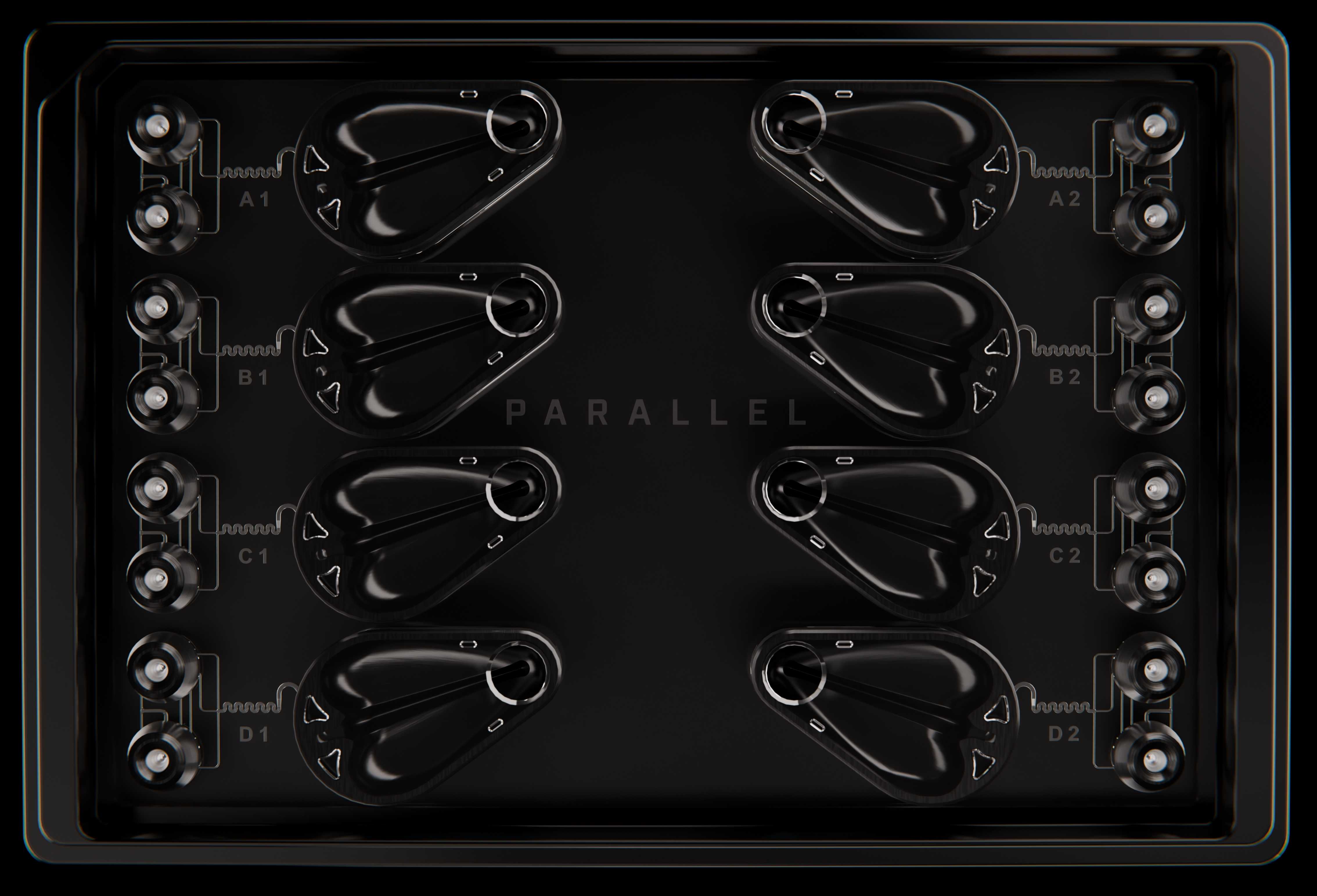
| Micromixer | One of the eight independent microfluidic mixers in each LNP Screening Array. Each micromixer produces and collects one formulation, so every formulation runs through a new micromixer. |
| Pipette interface | The pressure-tight point where a standard pipette tip seals to the LNP Screening Array. Through it, the liquid handler drives the lipid and aqueous phases into the micromixer with no tubing or pumps. |
| SLAS microplate format | The LNP Screening Array’s outer format, which matches the SLAS microplate footprint so it fits a standard deck position on standard liquid handlers. |
| Transition Molding | Our in-house manufacturing process for the LNP Screening Array, which produces the device in production-grade thermoplastic with micron-level accuracy so every micromixer is made to the same specification. |
Questions about your LNP screening workflow?
Our team works with LNP formulation on liquid handlers and can talk through any term, method, or screen design with you.