Sign in
Home
LNP Screening Array FAQ
Get the details you need to evaluate performance, compatibility, setup, and fit for your LNP screening workflow.
Product fit and workflow
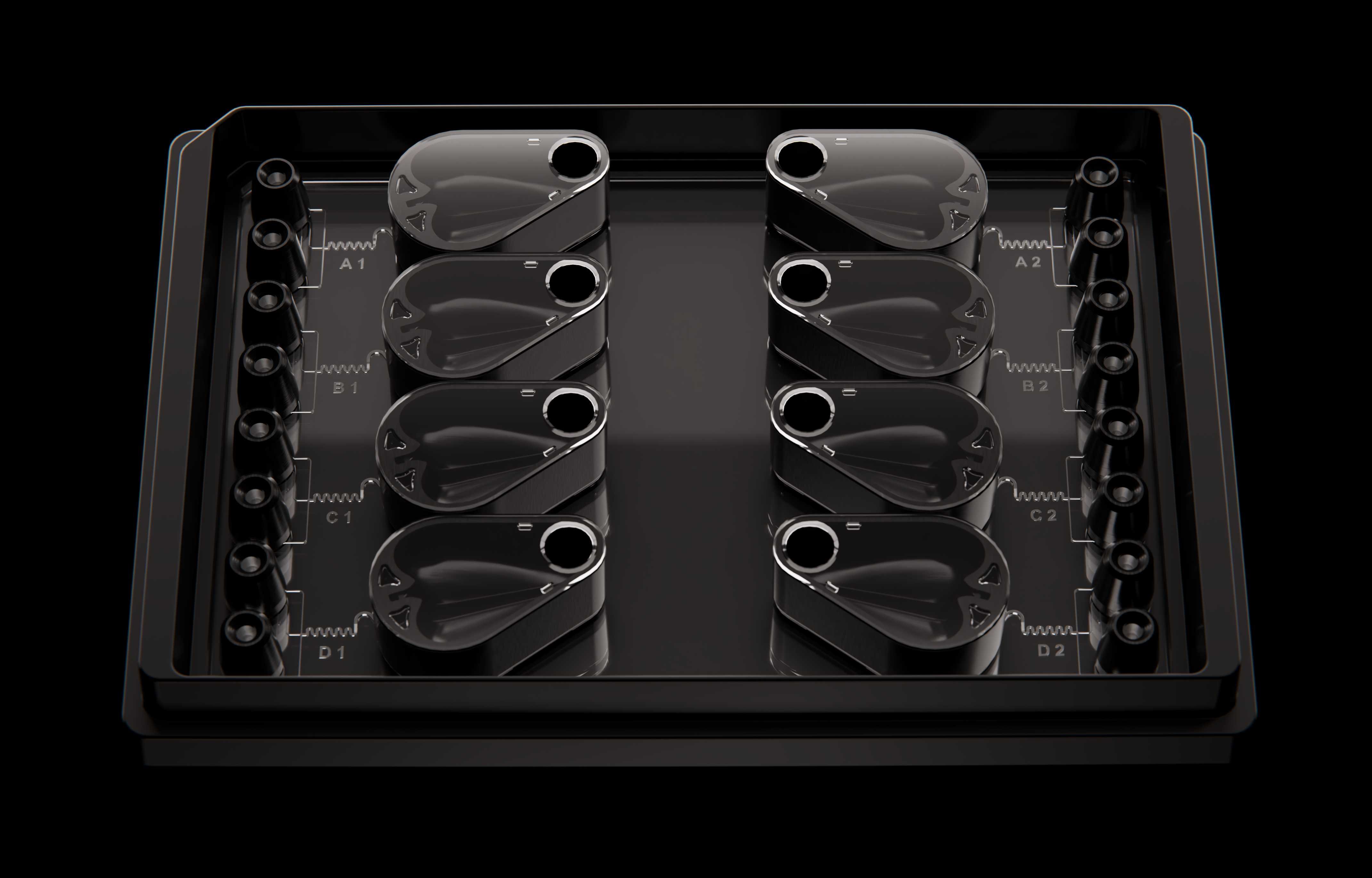
The LNP Screening Array is a microplate-format consumable that brings LNP formulation directly onto the liquid handler you already run. Reagent input, microfluidic mixing, and sample collection are combined in a single SLAS-footprint device, so formulations are generated in seconds and collected separately for downstream processing or analysis.
The LNP Screening Array is designed for LNP formulation teams that want to screen more conditions without adding a separate formulation instrument or moving the formulation step off deck.
It is best suited for teams already running liquid handling automation that need higher screening throughput, repeatable particle characteristics, and more efficient use of lipid, RNA, and other formulation materials.
The LNP Screening Array is a consumable, not a capital-equipment purchase. It runs on the liquid handlers already in your lab, so there is no standalone LNP formulation instrument to install or service.
Platform-specific automation protocols and application support are provided as part of the evaluation and setup process.
The main difference is where formulation happens. Dedicated systems move LNP formulation into a separate instrument and process samples sequentially. The LNP Screening Array occupies a standard deck position and runs as part of the liquid handler workflow, allowing reagent preparation and formulation to stay in one continuous automated sequence.
That matters most during screening, when the goal is evaluating more formulation conditions rather than producing a larger batch from one condition.
The LNP Screening Array sits between reagent preparation and downstream processing or characterization. Aqueous and lipid inputs are prepared in source plates, the liquid handler dispenses them into the array, and each formulation is collected in its own reservoir.
Formulated samples are then transferred into standard well plates for dilution, buffer exchange, particle characterization, encapsulation-efficiency testing, or biological evaluation, depending on the study.
No. The LNP Screening Array is designed to make microfluidic LNP formulation accessible through standard liquid handling workflows; no separate microfluidic instrument to design, operate, or maintain. We support protocol setup, workflow configuration, and first-run execution, so your team does not build the microfluidic workflow from scratch.
Your team still defines the lipid composition, cargo, process conditions, and downstream assays against its own scientific objectives.
Performance and reproducibility
In blank LNP testing on leading liquid handling platforms, the LNP Screening Array generated Z-average diameters below 60 nm, PDI below 0.15, and Z-average variability below 3% CV.
Results may vary based on lipid composition, cargo, process conditions, and automation platform.
Reproducible performance means that the same formulation conditions produce consistent LNP characteristics when repeated. Depending on the study, this may include consistency across replicate formulations, separate runs, arrays, deck positions, and liquid handlers.
Particle size and PDI are useful starting points, while a complete evaluation may also include encapsulation efficiency, concentration, recovery, and biological activity.
Z-average diameter describes the average particle size measured by dynamic light scattering. PDI indicates the breadth of the particle-size distribution, with lower values generally representing a more uniform LNP population. Percent coefficient of variation, or %CV, shows how much a measured result varies across replicate formulations relative to the average.
These metrics should be interpreted together and against the requirements of the specific application. A result appropriate for an early in vitro screen may not meet the requirements of a later development stage.
Characterized test conditions have shown Z-average variability below 3% CV, indicating consistent particle-size results across replicate formulations.
Confirm reproducibility with your own lipids, cargo, method, and liquid handler as part of the evaluation.
Yes. Liquid handlers use different pipetting technologies to generate and control flow, and air-displacement, positive-displacement, and pressure-controlled systems each require different protocol settings.
Every Starter Kit includes an automation protocol matched to your platform, with starting conditions set to reproduce the intended flow on the liquid handler you already run.
Yes. Lipid composition, cargo, solvent and buffer conditions, concentration, viscosity, flow rate ratio, and total flow rate can all affect particle size, PDI, encapsulation efficiency, and biological activity.
The LNP Screening Array provides controlled and repeatable mixing conditions, while formulation-specific performance should be confirmed using the intended materials and downstream assays.
Published characterization to date focuses on physicochemical performance: Z-average diameter, PDI, and Z-average %CV from blank LNP testing. Encapsulation efficiency and biological activity are application- and cargo-specific, and teams typically generate that data with their own constructs during evaluation.
Our applications team can help design the evaluation so those endpoints are captured alongside particle characterization.
Throughput and material use
Each LNP Screening Array contains eight independent micromixers, allowing up to eight formulations to be generated and collected separately.
Multiple arrays can run in the same liquid handler method, and teams have generated 100+ formulations per hour by scaling across deck positions.
The microfluidic formulation step occurs in seconds once the aqueous and lipid phases enter the micromixer. Total method time also includes reagent handling, channel priming, sample collection, and any downstream steps incorporated into the liquid handler protocol.
Yes. The LNP Screening Array is designed around multichannel liquid handling, allowing multiple micromixers to generate formulations during the same automated sequence.
Running formulations in parallel increases screening throughput and reduces the time between the first and last samples in a campaign.
Parallel formulation generates multiple conditions during the same run. Sequential workflows generate one formulation after another, so total campaign time increases with every condition and the earliest formulations can be significantly older than the last by the time the run finishes.
Running formulations in parallel reduces that time gap and allows larger groups of samples to move into downstream processing and characterization together.
The LNP Screening Array supports screening-scale volumes determined by the flow rate ratio, pipetting technology, formulation requirements, and liquid handler method. Each micromixer includes a dedicated reservoir that can collect up to 1 mL of formulated sample.
Starting volume should be selected against the material you have available and what downstream characterization or biological testing requires.
The LNP Screening Array has less than 50 µL of dead volume per formulation. Low dead volume preserves valuable lipid, RNA, and other limited inputs during screening.
The LNP Screening Array combines low-volume formulation with less than 50 µL of dead volume per formulation. Less material is consumed per data point, so teams can explore more conditions before committing larger quantities of RNA, lipids, or other components to a shortlist of candidates.
Material efficiency is especially valuable during cargo screening, early discovery, and other workflows where sample availability or cost limits the number of conditions that can be tested.
Throughput scales by adding LNP Screening Arrays to available deck positions and incorporating them into the liquid handler method. Total capacity depends on deck layout, pipette-head configuration, reagent and collection labware, and the broader screening workflow.
Screening capacity grows with the automation you already have, rather than with another formulation instrument.
Automation and compatibility
The LNP Screening Array is designed in an SLAS microplate format to fit standard liquid handler decks and to run on any platform that uses pipette tips.
We have configured workflows on platforms from Hamilton, Tecan, Formulatrix, Opentrons, and Dynamic Devices, and can evaluate other platforms based on their liquid-handling capabilities.
The LNP Screening Array is built around standard liquid-handler conventions, including a SLAS microplate footprint and pressure-tight pipette interfaces that connect directly with standard pipette tips. This allows the array to occupy a standard deck position and run through the liquid handler's existing pipetting workflow.
Compatibility also depends on your deck layout, pipetting configuration, labware setup, and screening workflow. We can review your existing automation setup and configure the protocol for your platform.
The LNP Screening Array uses one hardware configuration across supported platforms. What changes is the liquid-handler protocol.
Air-displacement, positive-displacement, and pressure-controlled pipetting systems generate and control flow differently, so aspiration, dispense, pressure, and timing parameters are adjusted to match the platform’s pipetting technology.
Flow rate is controlled through the liquid handler method, the pressure or dispense conditions generated by the pipette head, and the fluidic resistance of the micromixer.
A deck position for the array, standard reagent and collection labware, pipette tips, and a platform-specific automation protocol.
Exact setup depends on the liquid handler, pipette head, intended formulation volume, and any upstream or downstream steps included in the workflow.
Yes. Formulation runs as part of an automated liquid handler sequence once the reagents, labware, array, and method are prepared.
How much operator involvement remains depends on the broader workflow, including reagent preparation, plate handling, sample collection, and downstream processing.
The array supports walk-away formulation within a configured liquid handler run. Overnight operation depends on your liquid handler, deck capacity, automated plate handling, reagent stability, and broader automation setup.
Evaluate the full workflow, not the formulation step alone, when deciding whether an overnight run is appropriate.
Pressure-tight pipette interfaces create a secure seal between standard pipette tips and the microfluidic channels. This allows the liquid handler to drive the aqueous and lipid phases through each micromixer without external tubing or custom fluidic connections.
Integrated anti-backflow reservoirs collect each formulated sample separately and keep collected material from flowing back into the microfluidic channels.
Yes. Each formulation is collected in an open reservoir that can be accessed directly with pipette tips. The liquid handler can then transfer the samples into standard plates for dilution, buffer exchange, characterization, or biological testing.
Materials and device quality
The LNP Screening Array is manufactured from production-grade thermoplastics selected for solvent compatibility, dimensional consistency, and microfluidic performance.
Parallel Fluidics manufactures the array in-house using Transition Molding and high-performance thermoplastics that support repeatable device geometry across screening workflows.
Material selection can affect solvent compatibility, adsorption, channel dimensions, surface interactions, and device consistency. These factors can influence material recovery, flow behavior, and the reproducibility of the formulation process.
Materials should be evaluated alongside the formulation chemistry, operating conditions, and intended use.
Yes. The array is designed for standard LNP formulation workflows that combine an ethanol-based lipid phase with an aqueous buffer phase.
Let us review any solvents, additives, concentrations, or extended exposure conditions that fall outside a standard LNP formulation workflow.
RNA, lipids, and other formulation components can interact with device surfaces. Excessive adsorption can reduce recoverable sample, change the effective concentration of a component, or introduce variability between formulations.
Single-use LNP Screening Arrays reduce the risks associated with surface adsorption.
Production-grade thermoplastics provide controlled channel dimensions and are well suited to repeat manufacturing. They are also compatible with many solvent-containing workflows used in LNP formulation.
PDMS is useful for prototyping, but it can absorb hydrophobic molecules, swell in some organic solvents, and introduce dimensional variation that may be undesirable in repeat screening workflows.
For a deeper look at the tradeoffs between thermoplastics and PDMS, see our guide to material selection for microfluidic devices.
Arrays are manufactured using controlled processes and defined microfluidic geometries that support repeatable performance across orders.
The LNP Screening Array is designed and validated for single use to promote automation compatibility, reduce the risk of contamination between formulations, and increase screening throughput.
Ordering, lead times, and procurement
Quotes in 24 hours or less. Send us your liquid handler platform, expected formulations per month, and screening timeline, and we'll return a quote with the pricing model that fits your cadence.
Yes. Once your array configuration and automation protocol are established, repeat orders run against that setup; no requalification and no new quote cycle for each order.
Teams on a recurring monthly plan have their cadence set in advance and can adjust volume as program demand shifts.
On-demand customers can reorder directly against their established configuration. Screening volume can be turned up or down without a long-term contract.
Most teams start with a free in-lab evaluation rather than a direct purchase, and that's the path we recommend. It confirms fit with your liquid handler, reagents, and screening goals before any recurring commitment. Evaluation timing is scheduled around your team's availability and our applications support.
Once a configuration is established, standard arrays are stocked and can ship same-day. Custom configurations depend on the geometry involved and are confirmed in the quote.
Yes. Parallel Fluidics supports purchasing processes used by academic laboratories, research institutions, biotechnology companies, and pharmaceutical organizations.
We provide itemized quotes, accept purchase orders, and can supply the vendor documentation, tax forms, and product information your procurement or sourcing team requires. If your institution needs a specific quote format or vendor registration completed, tell us early and we'll work to your process.
Once the array configuration and workflow are established, repeat orders can be placed against your expected screening cadence and formulation volume.
Order planning can be adjusted as program demand changes, allowing teams to increase or decrease screening volume without adding another instrument.
Yes. Because the LNP Screening Array is a consumable, screening capacity increases by ordering more arrays and adding them to available deck positions.
Tell us as screening volume grows so supply can be planned against your program's cadence.
Evaluation and support
An evaluation includes LNP Screening Arrays for an initial run, an automation protocol configured for your workflow, guided setup on your liquid handler, and application support through first results.
Exact scope depends on your liquid handler, formulation goals, available reagents, and the data you want to generate.
Yes, and that’s how most teams start. An evaluation confirms fit with your liquid handler, formulation conditions, and performance requirements before any recurring commitment.
Once initial results are reviewed, the workflow moves into recurring screening using the configuration established during the evaluation.
Yes. We support in-lab evaluations using your liquid handler and workflow requirements.
We support liquid handler compatibility, protocol setup, initial method development, troubleshooting, and interpretation of early formulation results.
Our applications team can also identify appropriate starting conditions and determine whether a standard or custom array configuration best fits your workflow.
The initial review typically includes:
- Liquid handler make and model
- Target formulation volumes
- Target particle characteristics
- Lipid and cargo type
- Downstream processing and characterization steps
- Expected number of formulations per month
This information helps establish the appropriate array configuration and starting method, and lets us return an accurate quote within 24 hours.
Development transfer and scale-up
Yes. Screening results can help identify promising lipid compositions, cargo conditions, flow rate ratios, total flow rates, buffers, and other process variables.
These results provide a starting point for later process development, while transfer to a different scale or manufacturing system still requires additional comparability and validation work.
Teams can carry forward:
- Lipid composition and component ratios
- Cargo and buffer conditions
- Particle size and PDI
- Encapsulation efficiency
Documenting these variables during screening makes it easier to understand which conditions contributed to the selected formulation.
Moving to a larger-scale process may change the flow regime, batch volume, residence time, shear exposure, and downstream processing steps.
Teams should revalidate particle characteristics, encapsulation efficiency, recovery, stability, biological activity, and any critical process parameters on the intended scale-up system.
No. The LNP Screening Array helps teams identify promising formulations and understand how screening variables affect LNP characteristics, but it does not remove all process-transfer or comparability work.
A move to different equipment, mixer geometry, volume, or downstream process must still be evaluated and validated.