Sign in
Home
Does Microfluidic LNP Formulation Require a Pressure Controller?
By Joshua Gomes
Microfluidic LNP formulation needs controlled flow, and a liquid handler can supply it without a pressure controller or pump, keeping formulation and sample collection on deck with no separate flow hardware or manual transfers.
Microfluidic LNP formulation requires controlled flow
Microfluidic LNP formulation combines lipid and aqueous inputs in a mixer at controlled flow rates. Total flow rate (TFR) is the combined flow of both streams, while flow rate ratio (FRR) is the ratio of aqueous to lipid flow. Holding both constant helps ensure that differences across a screen come from the formulation variables being tested.
Pressure controllers, syringe pumps, and liquid handlers can all generate controlled flow.
| Flow source | How it moves the inputs | Workflow |
|---|---|---|
| Pressure controller | Pressurizes sealed reservoirs | Separate hardware and software |
| Syringe pump | Advances loaded syringes at a set rate | Separate pump, syringes, and tubing |
| Liquid handler | Dispenses through pipette tips at a programmed rate | Runs on the liquid handler deck with no added flow hardware |
For LNP screening, the practical difference is where controlled flow comes from and what has to happen around formulation. A separate flow-control system creates a distinct formulation step, while a liquid handler runs formulation and sample collection on its own deck without added flow hardware.
Pressure controllers add a separate fluid-handling system
Pressure-driven setups typically require a controller, reservoirs, tubing, and software. Those components add setup and hands-on work before, during, and after formulation.
| Component | Role | What it adds to the workflow |
|---|---|---|
| Pressure controller and software | Sets the pressure that drives each input | Calibration and run setup |
| Reservoirs | Hold the lipid and aqueous inputs | Refilling between formulations |
| Tubing and fittings | Connect the reservoirs to the mixer | Priming, cleaning, and dead volume |
| Collection vessels | Receive each formulated sample | Manual collection and transfer |
Dead volume is the lipid and cargo solution that remains in the tubing and fittings instead of reaching the collection vessel. Because formulation takes place on a separate system, each sample must also be transferred by hand for downstream dilution, plate prep, or characterization. These steps repeat across every formulation in the screen.
Your liquid handler can drive formulation on deck
The liquid handler can drive lipid and aqueous inputs through the mixer at a programmed flow rate. Formulation and sample collection both run on deck, and the same method can extend to dilution and plate prep when a lab wants to automate those steps.
| Workflow step | Pressure-driven setup | Liquid handler |
|---|---|---|
| Flow generation | Separate controller, reservoirs, and tubing | Programmed liquid handler flow |
| Formulation | Separate system | On deck |
| Between formulations | Refill reservoirs and collect each sample by hand | Moves to the next formulation under the same protocol |
| Sample collection | Manual | On deck |
| Dilution and plate prep | After manual transfer | Can run on deck in the same method |
The liquid handler moves from one formulation to the next under the same protocol, so the screen does not have to stop for reservoir refilling, sample transfer, or movement between systems. Formulated samples remain on deck until the lab is ready for the next step.
Microfluidic formulation becomes a programmed step on the liquid handler instead of a separate process on its own system. Labs can run formulation as a standalone method or add dilution and plate prep to it later.
The LNP Screening Array needs no separate pressure controller or pump
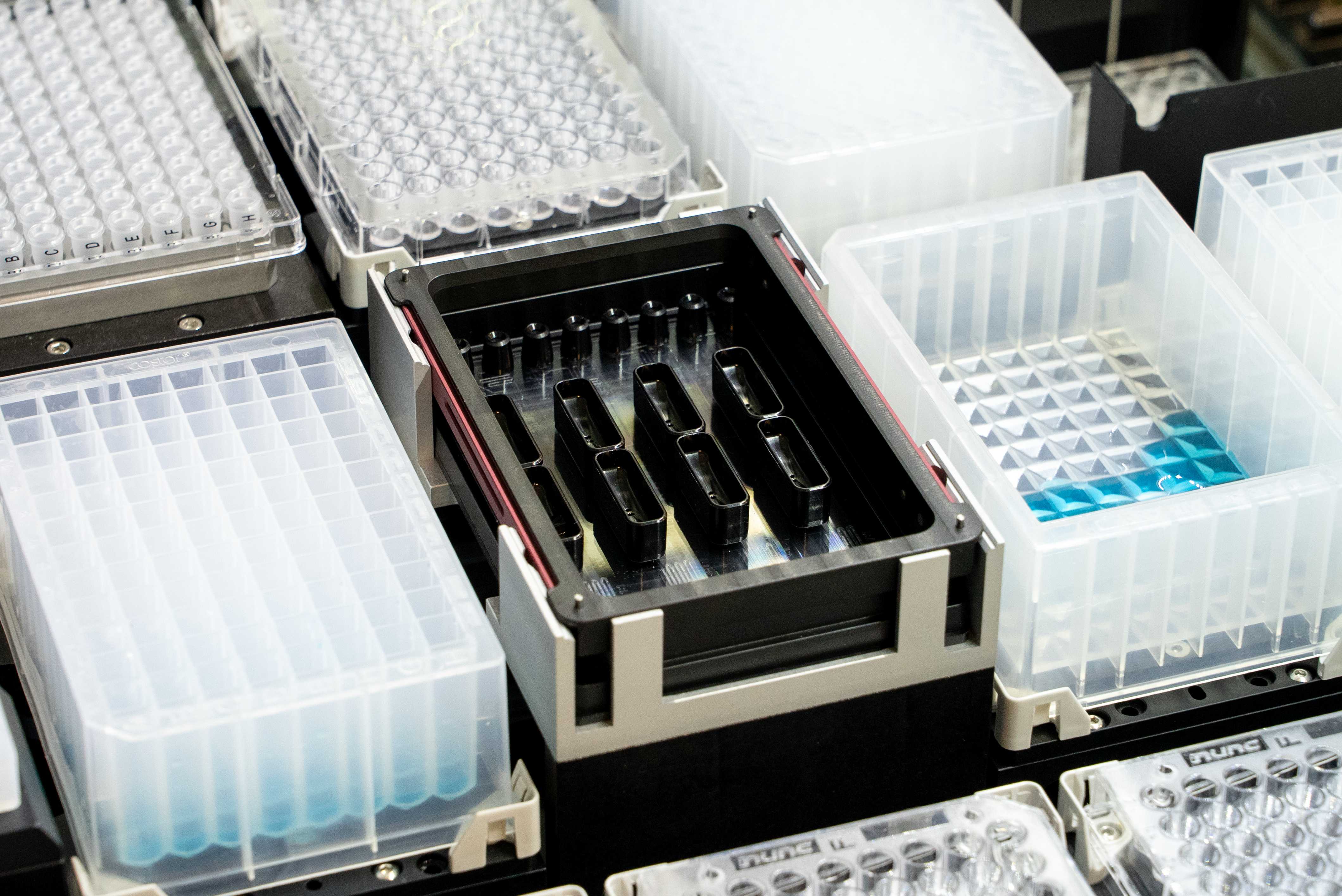
The LNP Screening Array connects directly to the liquid handler through standard pipette tips. Each LNP Screening Array has eight independent single-use mixers, and the liquid handler drives each formulation through its own mixer.
| Flow requirement | How the LNP Screening Array meets it |
|---|---|
| Flow source | Liquid handler, with no separate pressure controller or pump |
| Connection | Standard pipette tips, with no external tubing |
| Total flow rate | Set by the automation protocol |
| Flow rate ratio | Held constant at 3:1 |
| Sample collection | Output reservoirs on deck |
The result is a microfluidic formulation workflow that stays on the liquid handler from input delivery through sample collection. Each formulated sample remains on deck, ready for dilution and plate prep on the same instrument or transfer to characterization.
For a step-by-step view of the process, see How the LNP Screening Array Works.
Evaluate the LNP Screening Array in your lab
Evaluate the LNP Screening Array on your own liquid handler with your lipids and cargo, using your current method as the benchmark.