Sign in
Home
How Much RNA Does Each Formulation Use in an LNP Screen?
By Joshua Gomes
The RNA in each LNP formulation equals your chosen RNA concentration times its aqueous volume, plus what the workflow loses, so formulating only the volume your assays and processing need leaves more RNA for every lipid or cargo you screen.
Calculate RNA per formulation from concentration and volume
Calculate the RNA entering a lipid nanoparticle (LNP) formulation by multiplying your chosen RNA concentration in the aqueous input by the aqueous volume delivered to the mixer. Use the concentration of the prepared aqueous phase before it mixes with the lipid phase.
RNA input (µg) = aqueous RNA concentration (µg/µL) × aqueous volume (µL)
At a 3:1 aqueous-to-lipid flow rate ratio (FRR), the aqueous phase contributes three quarters of the combined mixing volume. For example, 100 µL of combined input contains 75 µL of aqueous phase, giving 7.5 µg of RNA at 0.1 mg/mL. The table shows how RNA input changes with volume and concentration.
| Combined mixing volume | RNA input at 0.1 mg/mL | RNA input at 0.2 mg/mL | RNA input at 0.4 mg/mL |
|---|---|---|---|
| 100 µL | 7.5 µg | 15 µg | 30 µg |
| 200 µL | 15 µg | 30 µg | 60 µg |
| 500 µL | 37.5 µg | 75 µg | 150 µg |
| 1 mL | 75 µg | 150 µg | 300 µg |
All concentrations refer to the aqueous input; all values assume a 3:1 FRR and exclude additional input for priming or overage. Combined mixing volume is the sum of the aqueous and lipid volumes delivered for mixing, before dilution, post-processing, or dead volume.
At a fixed RNA concentration and FRR, halving the mixing volume halves RNA input. The amount recovered in the collected sample and the fraction encapsulated must be assessed separately.
Match formulation volume to your assays and processing
Select formulation volume by working backward from the planned characterization and biological testing. Buffer exchange can set a minimum working volume even when analytical aliquots are small, and recovery determines how much material remains for those assays.
| Downstream step | What to allow for |
|---|---|
| Buffer exchange | Minimum working volume and expected recovery through the chosen process |
| Dynamic light scattering (DLS) | Aliquots and dilution for particle size and polydispersity index (PDI) measurements |
| Encapsulation efficiency | Aliquots for intact and disrupted LNP measurements, including assay replicates |
| In vitro testing | RNA required across the planned doses, wells, and cell models |
| Repeat measurements | A defined reserve for planned rechecks |
Add the aliquots that will be drawn from each sample, then check that processing can supply them at the required concentration. A sample may pass through buffer exchange before it is divided among assays, so the minimum volumes for sequential steps cannot simply be added together. Dilution increases volume without adding RNA.
The smallest useful preparation covers that complete workflow, including a practical reserve. Larger volumes make sense when the testing plan requires more material.
Count the RNA consumed across the workflow
Total RNA consumption includes material used before collection and any excess sample produced to meet a platform’s minimum output volume. Compare methods against the same downstream sample requirements so differences in RNA use reflect the workflow being evaluated.
| Source of RNA use | What to include in the budget |
|---|---|
| Priming and startup | RNA-containing liquid used to establish flow and discarded before sample collection |
| Unrecoverable material | RNA left in source wells, tips, tubing, connections, or devices |
| Minimum sample volume | RNA in excess sample when the platform requires a larger preparation than testing needs |
These contributions depend on the protocol and screen design. Repeated preparations from the same inputs may share a startup volume, while changing cargo, lipid inputs, or process conditions may require fresh loading or priming.
Count each RNA-containing volume once, whether it reaches collection or remains in the fluid path. Use the total amount consumed when planning material requirements and evaluating cost per LNP formulation.
Plan the RNA budget for the screen you are running
A lipid screen can draw from one RNA supply across many lipid candidates. A cargo screen has a separate material constraint for each RNA candidate, so a single total for all RNA can hide a shortage that prevents one candidate from completing the planned tests.
| Screen type | What varies | How to budget RNA |
|---|---|---|
| Lipid screen | Lipid candidates or compositions with one RNA | Sum RNA use across all conditions and independent preparations using that RNA |
| Process screen | Mixing conditions for one lipid–RNA combination | Calculate input for each condition and include material used when the setup changes |
| Cargo screen | RNA candidates under defined lipid conditions | Budget each RNA separately across its conditions, independent preparations, and follow-up work |
For example, 24 lipid candidates prepared independently in triplicate require 72 preparations. At a 3:1 FRR and an aqueous RNA concentration of 0.1 mg/mL, delivering 100 µL of combined input per preparation uses 540 µg of RNA across the screen; 200 µL per preparation uses 1,080 µg.
These are mixing-input totals. Build the final budget from the actual volumes loaded, including any additional material consumed during setup, and reserve RNA for planned confirmation runs. If concentration, FRR, or volume changes across conditions, calculate each condition separately.
Formulate as little as 100 µL with the LNP Screening Array
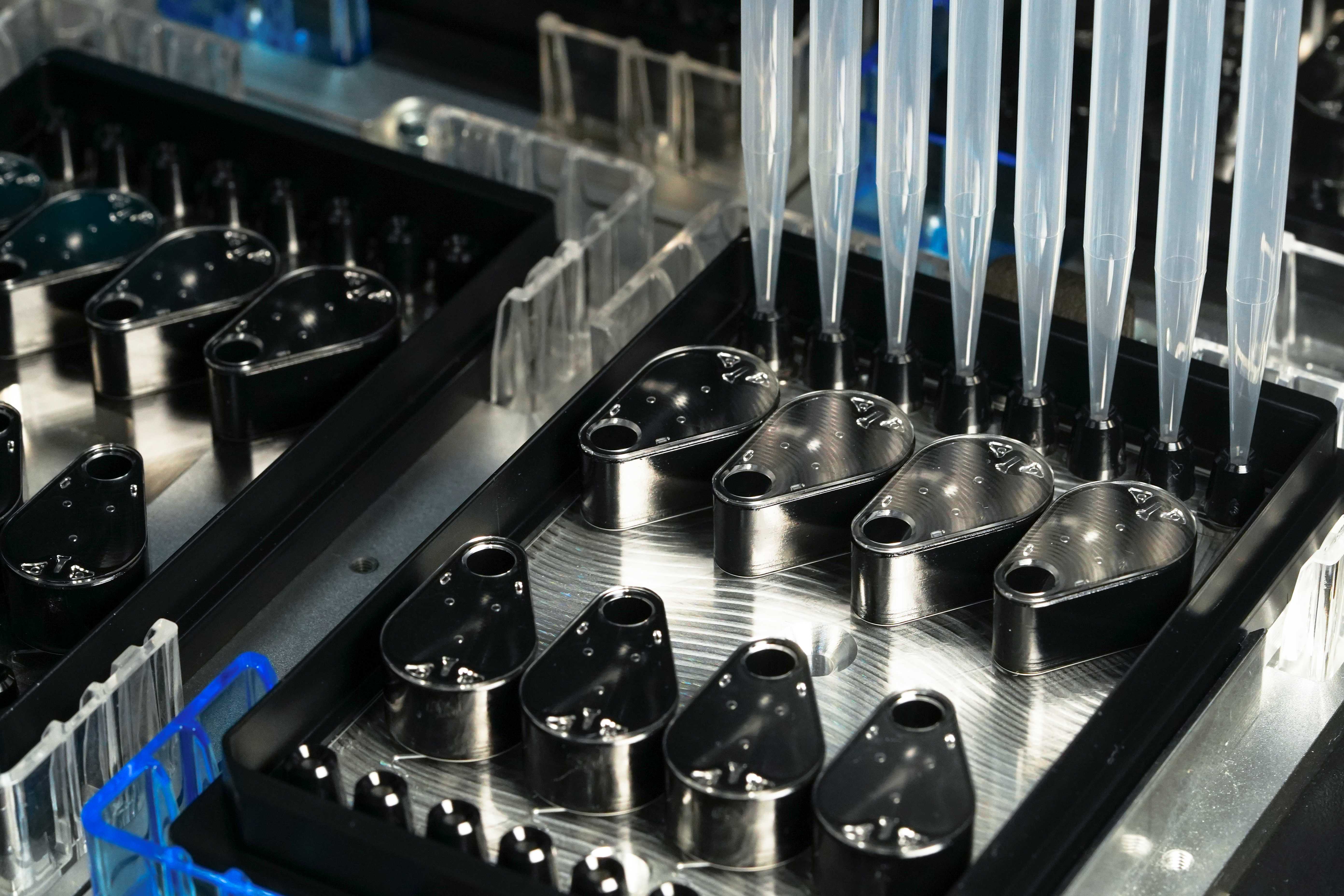
Bring microfluidic formulation onto your supported liquid handler with the LNP Screening Array, which supports a minimum sample output of 100 µL. When that volume meets processing and assay requirements, you can avoid making a larger preparation solely to satisfy an instrument’s minimum volume.
| Screening requirement | LNP Screening Array capability |
|---|---|
| Small sample outputs | Formulate as little as 100 µL per preparation |
| Direct reagent delivery | Pipette tips engage the device without external tubing, minimizing reagent loss |
| Flexible sample volumes | Select the output needed for your workflow, with collection reservoirs that accommodate up to 1 mL per formulation |
Set the input volumes for your target sample output using the automation protocol and measured recovery. Each formulation is collected automatically on deck for post-processing, keeping sample handling connected to the formulation step.
Measure RNA use in your evaluation
Evaluate RNA use with the LNP Screening Array on your own liquid handler, using your RNA, lipids, and target sample volume. Get applications support to compare total RNA consumption and recovered sample against your current workflow, and confirm that the output supports your planned testing.