Sign in
Home
LNP Screening Array vs. TAMARA
By Joshua Gomes
TAMARA formulates LNPs sequentially on a dedicated pressure-driven benchtop system, with operator handling and cleaning between formulations. The LNP Screening Array runs directly on a liquid handler, generating 100+ formulations per hour while automating input delivery, parallel formulation, and sample collection across the screen.
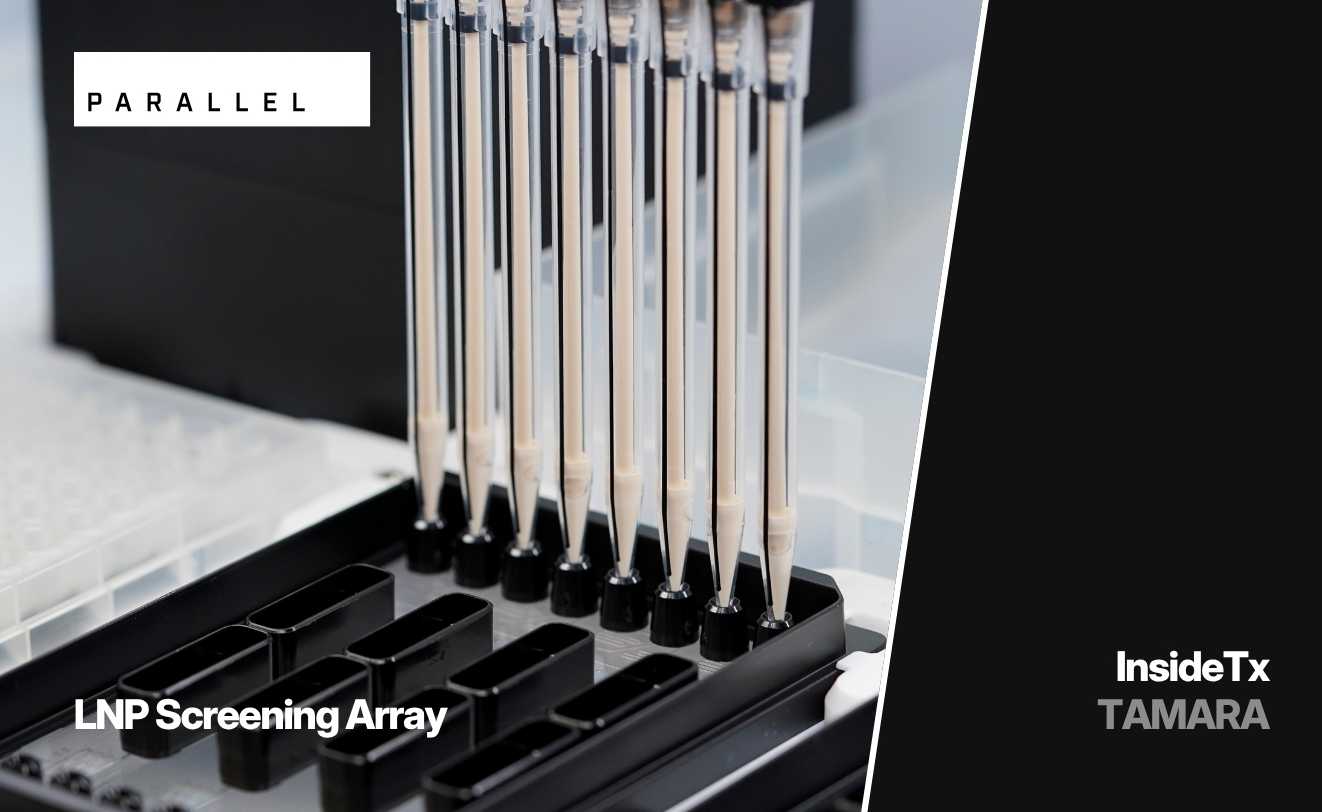
LNP Screening Array vs TAMARA
TAMARA and the LNP Screening Array both use microfluidic mixing for LNP formulation, but they are designed around different screening workflows.
TAMARA processes one formulation at a time on a dedicated controller and synthesis system. Each run requires the operator to load formulation inputs, prepare the chip and collection hardware, recover the sample, and complete the required cleaning workflow before the next formulation.
The LNP Screening Array moves formulation onto the liquid handler. Eight micromixers sit in each SLAS-format array, while the liquid handler delivers inputs, generates multiple formulations, collects samples, and can continue directly into downstream liquid handling steps.
| Comparison | LNP Screening Array | TAMARA |
|---|---|---|
| Platform | Runs on a liquid handler | Dedicated benchtop formulation system |
| Flow source | Liquid handler | Separate filtered gas supply at 8-10 bar inlet pressure |
| Screening model | Multiple formulations generated in parallel | Formulations run sequentially |
| Formulation speed | 100+ formulations per hour | 15 formulations per hour |
| Mixer format | 8 micromixers per array, with one fluidic path per formulation | Reusable microfluidic chip |
| Between formulations | No cleaning, blank run, or purge step required | Additional manual chip and reservoir cleaning protocol required between runs; blank-run and purge steps recommended for chip reuse |
| Operator handling | Inputs dispensed and samples collected by the liquid handler | Inputs manually pipetted, formulation hardware prepared, and collection vial handled by the operator |
| Downstream handling | Samples remain accessible on deck for additional post-processing steps | Samples manually collected from the dedicated formulation system by the operator |
Screen more formulations per hour
TAMARA's individual formulation run takes minutes, and every screening condition remains a separate run. As the screen grows, the operator repeats the sample-loading, formulation setup, collection, and between-run workflow for every condition.
The LNP Screening Array distributes those conditions across eight independent micromixers per array. Additional arrays can be incorporated across available deck positions, allowing the liquid handler method to move through the screen without restarting the formulation workflow for every sample.
| As the screen expands | LNP Screening Array | TAMARA |
|---|---|---|
| Formulation paths | Up to 8 | 1 |
| 8 formulation conditions | 1 array | 8 sequential formulation cycles |
| 24 formulation conditions | 3 arrays | 24 sequential formulation cycles |
| How capacity expands | Add arrays across available deck positions | Add sequential formulation runs |
Reduce hands-on work across the screen
TAMARA automates pressure-driven microfluidic mixing, but it requires the operator to prepare and reset the system around every formulation. Each run starts with pipetting formulation inputs into the reservoirs, seating a new gasket and the chip, closing the synthesis module, and installing the collection vial, which the operator recovers after the run.
With the LNP Screening Array, those recurring formulation tasks become part of the automated liquid handler method: reagents are dispensed into the array, each formulation collects in its own output reservoir, and the automated workflow can continue directly into transfer, dilution, plate preparation, or other downstream handling.
| Screening task | LNP Screening Array | TAMARA |
|---|---|---|
| Deliver formulation inputs | Automated from source labware | Manually pipetted into reservoirs by the operator |
| Prepare formulation hardware | Array loaded as deck labware at setup | Reservoir, gasket, and chip prepared in the synthesis module |
| Set up sample collection | Integrated output reservoirs | Collection tube installed by operator |
| Recover formulated sample | Accessible directly to liquid handler | Collection tube retrieved by operator |
| Continue into downstream handling | Can continue within the same method | Sample transferred into the downstream workflow by hand |
Move directly from one formulation to the next
TAMARA's published run time does not represent the entire interval between formulations. After a run is complete and the sample is collected, InsideTx instructs users to clean and flush the system before running the next batch.
Its standard cleaning workflow includes purging remaining liquid, loading cleaning solutions, and flushing the system. When a chip is reused, InsideTx also recommends a solvent/water blank run to verify flow and a thorough purge to ensure the chip is dry before the next formulation.
With the LNP Screening Array, each formulation uses its own micromixer and collects in its own output reservoir, so the automated liquid handler method moves from one formulation to the next with no cleaning, blank run, or chip setup in between.
| Before the next formulation | LNP Screening Array | TAMARA |
|---|---|---|
| Purge residual formulation | Not needed | Required |
| Load cleaning solutions | Not needed | Required |
| Flush chip and reservoir | Not needed | Required |
| Verify chip before reuse | Not needed | Recommended |
| Dry fluidic path | Not needed | Recommended |
| Proceed to next formulation | Automated method continues | Begin next run after cleaning and preparation |
Formulate without a dedicated pressure system
TAMARA requires dedicated Controller and Synthesis modules plus an external pressure source to drive formulation. Its current specifications call for dry gas at an ideal inlet pressure of 8-10 bar and at least 15 minutes of warm-up before experiments.
The LNP Screening Array runs on a liquid handler already used for automated sample preparation. Formulation occupies a standard SLAS deck position, with no separate pressure-driven formulation system or warm-up period before screening can begin.
| System requirement | LNP Screening Array | TAMARA |
|---|---|---|
| Added formulation modules | Not needed | Controller + Synthesis modules |
| Formulation footprint | Standard SLAS deck position | Controller - 31 × 34 × 36 cm (5.05 kg) Synthesis - 23 × 26 × 23 cm (3.65 kg) |
| External pressure supply | Not needed | Dry, filtered gas; 8–10 bar recommended |
| Formulation system warm-up | Not needed | 15 minutes recommended |
| Formulation control | Existing liquid handler method | Dedicated touchscreen controller |
Evaluate the LNP Screening Array in your lab
Run your own formulations on the liquid handler already in your lab using your lipids, cargo, and screening criteria.
We provide the LNP Screening Arrays and a configured automation protocol for your liquid handler, and our applications team helps you run the first screen with you.