Sign in
Home
Single-Use vs. Reusable Microfluidic Chips for LNP Screening
By Joshua Gomes
Single-use mixers on a liquid handler remove the cleaning and requalification of reusable chips and the manual cartridge changes of benchtop systems, so LNP screens run faster with less hands-on time.
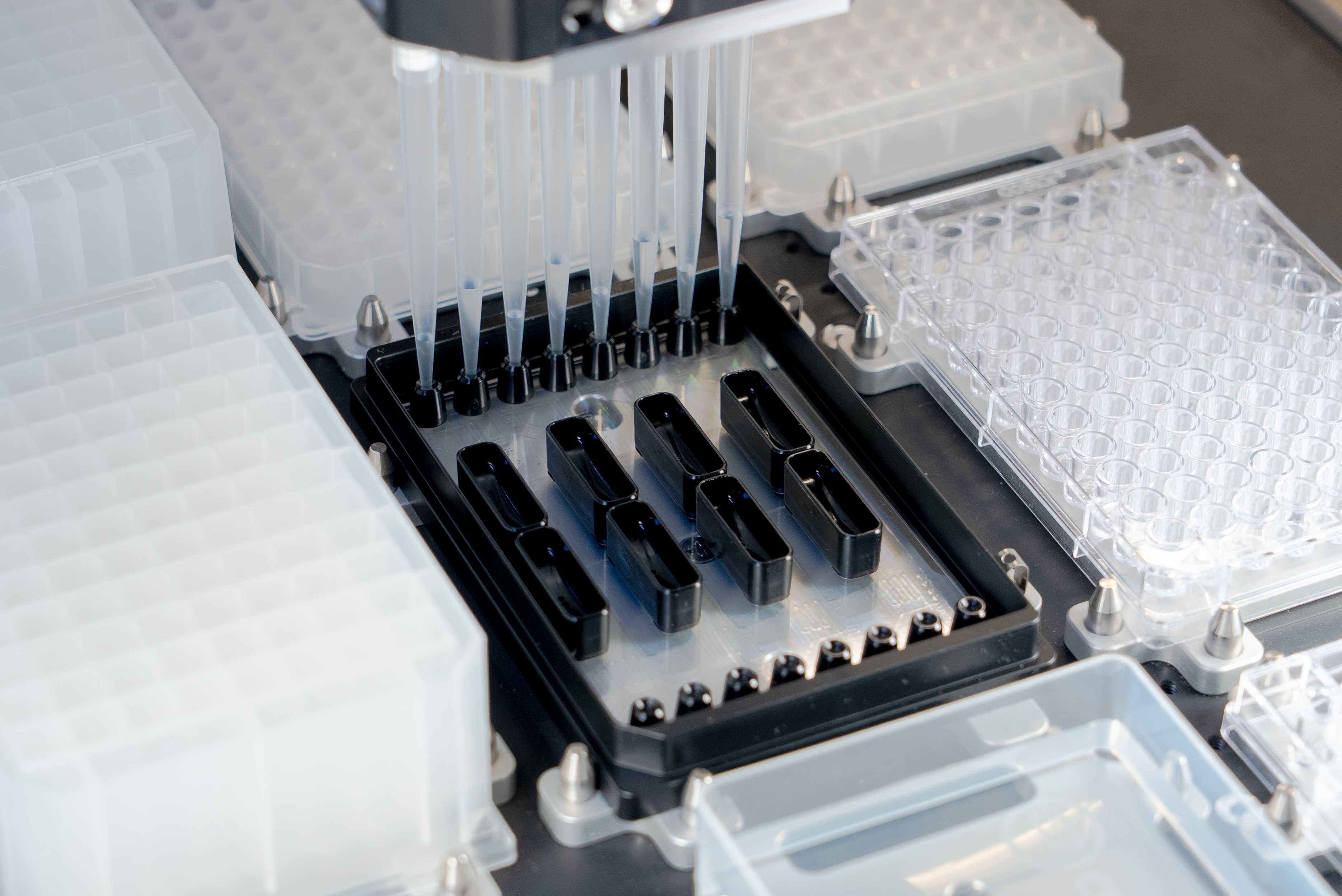
Compare single-use and reusable microfluidic chips
Microfluidic chips for LNP formulation use either a reusable fluidic path that is cleaned between formulations or a new single-use path for each formulation. That choice determines whether cleaning, carryover controls, and requalification are required.
Carryover is residual material from an earlier formulation that remains in the fluidic path and enters a later one. Requalification confirms that a reused chip still performs as expected, typically by rerunning a control formulation with known characterization results.
Single-use formats differ in how the workflow moves between formulations. On a benchtop instrument, a scientist changes each cartridge by hand, while a liquid handler moves directly from one mixer to the next.
| Consideration | Reusable chips | Benchtop single-use | Single-use on a liquid handler |
|---|---|---|---|
| Fluidic path | Reused across formulations | New cartridge for every formulation | New mixer for every formulation |
| Between formulations | Solvent and buffer flush | Manual cartridge change | Liquid handler moves directly to the next mixer |
| Carryover control | Validated cleaning protocols and run tracking | Not needed | Not needed |
| Performance checks | Control formulations rerun to confirm performance | Not needed | Not needed |
| Primary added work | Cleaning, validation, run tracking, and control runs | Cartridge handling for every formulation | None |
Reusable chips require cleaning and performance checks
After each formulation, a reusable chip is flushed with solvent and buffer to clear lipid, cargo, and ethanol from the channels before the next inputs arrive. Each flush takes instrument time, consumes solvent, and produces waste that must be collected and disposed of.
Because lipids can adsorb to channel surfaces, teams also validate the cleaning protocol to show it limits carryover. They track how many runs each chip has completed, and may rerun a known control formulation to confirm that a reused chip still performs as expected.
| Step between formulations | What it involves | What it adds to the screen |
|---|---|---|
| Solvent and buffer flush | Clearing lipid, cargo, and ethanol from the channels | Instrument time, solvent, and waste |
| Cleaning validation | Confirming the protocol limits carryover for the lipids and cargo in use | Method development and documentation |
| Run tracking | Recording how many formulations each chip has carried | Record keeping and chip replacement decisions |
| Control formulation | Rerunning a reference formulation with known results | Lipid, RNA, and run time |
These steps help control carryover and verify performance, but each control run consumes lipid, RNA, instrument time, and additional work, without adding new data to the screen.
Single-use chips eliminate cleaning between formulations
With a single-use chip, each formulation runs through a new fluidic path, so the chip does not need to be cleaned or requalified between formulations. Single-use workflows can differ in what happens between formulations.
In a benchtop cartridge system, a scientist typically fills the cartridge, loads it into the instrument, and recovers the formulated sample by hand. With single-use mixers designed for a liquid handler, the automation delivers the inputs, collects the sample on deck, and moves directly to the next mixer.
| Single-use format | Handling for each formulation | Between formulations |
|---|---|---|
| Cartridge on a benchtop instrument | Scientist fills the cartridge, loads it, and recovers the sample by hand | Manual cartridge change |
| Single-use mixer on a liquid handler | Liquid handler delivers the inputs and collects the sample on deck | Liquid handler moves to the next mixer |
Both single-use formats eliminate cleaning and requalification. A liquid handler also removes the manual cartridge change by moving directly to the next mixer.
Total cost includes cleaning, labor, and equipment
Chip price alone does not capture the full cost of an LNP screen. Reusable chips spread their purchase price across many runs, while each run still adds cleaning materials, hands-on time, and periodic control formulations.
Benchtop single-use systems add the cost of a new cartridge for each formulation, scientist time for each cartridge change, and a dedicated formulation instrument.
Single-use mixers on a liquid handler carry a consumable cost for each formulation and run on the lab's existing liquid handler, with no cleaning or manual cartridge changes between formulations.
| Cost component | Reusable chips | Benchtop single-use | Single-use on a liquid handler |
|---|---|---|---|
| Chip or consumable | Purchase price spread across runs | New cartridge for each formulation | New single-use mixer for each formulation |
| Cleaning materials | Solvent and buffer for every flush | Not needed | Not needed |
| Hands-on work between formulations | Flushing, setup, and control runs | Manual cartridge change | Not needed |
| Materials used for performance checks | Lipid and RNA spent on control formulations | Not needed | Not needed |
| Equipment | Depends on the reusable-chip system | Dedicated benchtop formulation instrument | Existing liquid handler |
Every repeated step adds time, labor, or materials across a full screen, so looking holistically at total screening cost is more useful than chip price alone.
The LNP Screening Array brings single-use mixing to your liquid handler
The LNP Screening Array is a set of single-use micromixers built to run on a liquid handler. Each array contains eight independent micromixers in a SLAS microplate footprint and sits in a standard liquid handler deck position.
The liquid handler produces each formulation in seconds and moves directly to the next mixer with no cleaning or cartridge change. Each formulated sample is collected in its own output reservoir on deck, and the liquid handler can continue directly into dilution and plate preparation for characterization.
| Screening step | How the LNP Screening Array supports it |
|---|---|
| Setup | Automation protocol configured for your liquid handler |
| Between formulations | A new single-use mixer for every formulation, with no cleaning or requalification |
| Formulation | Each formulation produced in seconds on the liquid handler |
| Sample collection | Each formulated sample collected in its own output reservoir on deck |
| Dilution and plate prep | The liquid handler continues in the same method |
For a step-by-step look at the workflow, see How the LNP Screening Array Works.
Evaluate the LNP Screening Array in your lab
Evaluate the LNP Screening Array on your own liquid handler with your lipids and cargo, using your current method as the benchmark.