Sign in
Home
What Determines the Cost per LNP Formulation?
By Joshua Gomes
The cost of an LNP formulation includes more than the device and materials used for each run. Material lost during formulation, scientist hands-on time, and the time required to complete the full screen can add substantial cost as the number of conditions increases.
What contributes to the cost of one LNP formulation?
When formulation teams ask what one LNP formulation costs, the device or per-run price provides a useful starting point. But those costs do not capture material that is prepared and never recovered, scientist time spent setting up and handling each formulation, or the time required to generate every condition in the screen. Those are hidden costs, and they can add up quickly as the screen grows.
Start with the visible cost of a formulation
Teams can usually price the visible inputs of a formulation first, and these form the baseline for comparison.
| Category | What it includes |
|---|---|
| Materials | Cargo, lipids, buffers, ethanol, dilution reagents |
| Consumables | Devices, tips, plates, tubes, reservoirs, seals |
| Equipment | Capital costs, service, software, maintenance, dedicated infrastructure |
Materials, consumables, and equipment usually have known unit costs.
These are the costs teams can typically put a dollar value on before formulation begins. The hidden costs appear during the work itself: material that is lost, scientist hours spent on manual steps, and the time required to formulate the full screen.
Hidden cost #1: Material loss
Material loss becomes especially important when RNA, custom-synthesized cargo, or lipids are limited or expensive. Teams often prepare more material than they ultimately recover for use. The difference is material they have paid for but cannot use in an experiment.
Common sources of material loss include:
- Overage: Additional material prepared to ensure enough volume is available to complete the process
- Priming: Material used to fill tubing, channels, or other components before formulation begins
- Dead volume: Material retained in the device, connections, reservoirs, or tubing
- Incomplete recovery: Formulated material that does not reach the final collection vessel
For a single condition, unrecovered sample may seem negligible, but across larger screens it accumulates into milliliters of lipid and RNA that never reach characterization or downstream experiments. Even common reporter RNAs like FLuc, GFP, and mCherry all cost $1-3k per mg, while custom synthesized RNA is more expensive still. As little as 100 microliters of material loss per formulation quickly leads to thousands of dollars in waste across a 96 formulation screen.
Hidden cost #2: Hands-on-labor
Hands-on labor is the time a scientist spends actively operating the formulation workflow, which is separate from the time an instrument runs on its own. On most benchtop systems, that active time comes from the most expensive people in the lab, and it goes to work that has nothing to do with formulation science.
Putting an approximate cost on that time shows why it matters. Publicly reported salary data puts a formulation scientist's base pay around $50 an hour, with biotech roles trending higher. After benefits and overhead, which commonly add 30 to 40 percent, fully loaded time lands on the order of $75 to $100 an hour. The lab carries that cost whether the hour goes to designing the next experiment or to rinsing lines between conditions.
Every condition in a screen runs the same manual loop:
- Carry inputs and samples between the liquid handler and a separate formulation instrument
- Prepare the lipid and aqueous inputs
- Prime the lines and start the run
- Wait for the run to complete
- Recover the formulated sample by hand
- Clean and reset the hardware
No single step is difficult, which is exactly the point. Skilled scientists are doing unskilled work, and the invoice reads the same either way. The cost lives in the repetition.
Even at a conservative 15 minutes of hands-on time per condition:
| Screen size | Hands-on time | Fully loaded labor cost |
|---|---|---|
| 24 formulations | 6 hours | $450 to $600 |
| 96 formulations | 24 hours | $1,800 to $2,400 |
That is skilled time spent before a single particle is measured, and it is time not going to the experimental design and data interpretation that actually move a program forward.
Hidden cost #3: Time
Formulation time becomes a significant cost driver at screen scale. On a dedicated instrument that processes formulations one at a time, a 96-formulation screen can extend across several days and, in some workflows, approximately one working week. The LNP Screening Array supports more than 100 formulations per hour, bringing the formulation portion of a 96-formulation screen to approximately one hour under the configured method.
Every additional day keeps the formulation step open longer, occupies equipment, and can add scientist time for setup, monitoring, transfers, and coordination. Those costs continue to accumulate until the full screen is complete.
The LNP Screening Array processes four independent formulations concurrently on the liquid handler. Conditions move through formulation in groups of four, shortening the total run without implying that all 96 formulations occur simultaneously. Across the full screen, this parallel execution supports up to 10 times the formulation rate of a dedicated formulation instrument.
The same two screens show how far apart that puts the formulation time:
| Screen size | Benchtop systems | LNP Screening Array |
|---|---|---|
| 24 formulations | 1-2 days | < 15 minutes |
| 96 formulations | 1 week | <1 hour |
A 96-condition screen that fills a scientist's week collapses to a single on-deck run that finishes before lunch. The time you take back is equipment freed for other work, skilled attention returned to the science, and a formulation set that reaches characterization and the next decision sooner.
How the LNP Screening Array changes the cost model
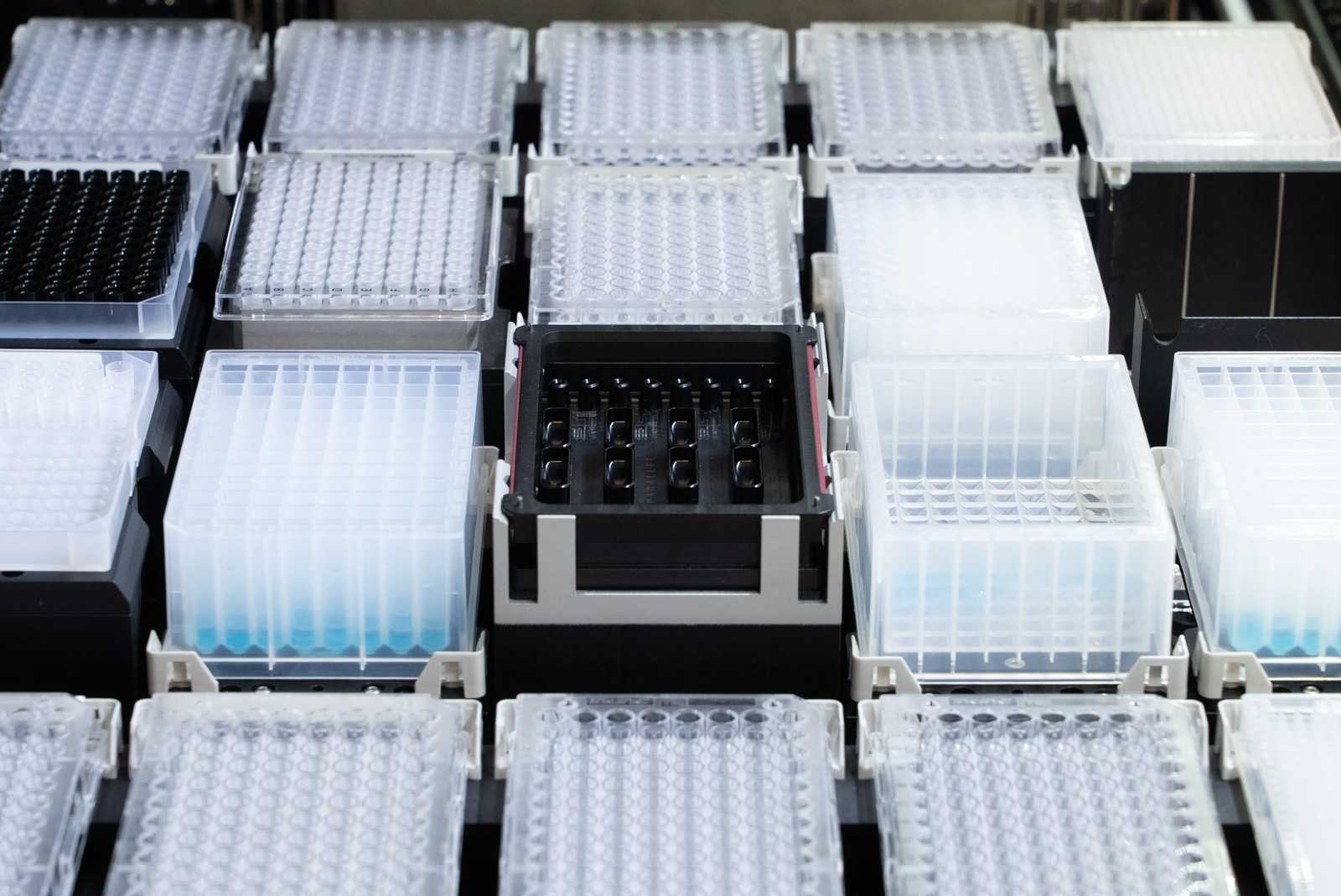
The LNP Screening Array brings microfluidic formulation onto standard liquid handlers already used in the lab. The liquid handler delivers the lipid and aqueous inputs through the array, and each formulation collects on deck in a dedicated output reservoir.
This setup affects the cost drivers behind each formulation.
Preserve more of the available material
The LNP Screening Array has less than 50 µL of dead volume per formulation, leaving less RNA, lipid, and formulated material behind in the device.
Across a larger screen, preserving more material at each condition allows more of the starting cargo to reach downstream experiments.
Remove transfers between formulation systems
Input delivery, formulation, and collection remain on the liquid handler. Scientists do not need to move prepared inputs to a separate formulation instrument and then return each output to the liquid handler.
This removes manual handoffs and reduces the time spent transferring samples, managing fluidic connections, and tracking material between systems.
Use existing automation
The LNP Screening Array extends an existing liquid handler from reagent preparation and sample handling into microfluidic LNP formulation.
Teams can increase screening capacity without relying on a dedicated instrument or a separate off-deck process. They also avoid adding another system to install, train on, and maintain.
Together, these changes map to the cost drivers behind a screen:
| Cost driver | LNP Screening Array | Why it matters |
|---|---|---|
| Equipment | Formulation runs on a liquid handler already in the lab | Extends existing automation into microfluidic formulation |
| Formulation throughput | Eight independent micromixers support parallel formulation and generates LNPs in seconds | Distributes setup time across more conditions and shortens campaign duration |
| Material loss | Less than 50 µL of dead volume per formulation | Preserves more lipid, RNA, and other limited inputs |
| Hands-on time | Input delivery, formulation, and collection remain on deck | Removes transfers between systems and consolidates the workflow within one automation platform |
For a step-by-step look at the process, see How the LNP Screening Array Works.
Evaluate the LNP Screening Array
The Starter Kit provides a direct path to run the LNP Screening Array on the liquid handler, with a matched automation protocol and application support through first results.
Contact us to discuss your workflow or request the LNP Screening Array Starter Kit to begin testing.