Sign in
Home
What to Look for in an Automated LNP Formulation Workflow
By Joshua Gomes
Automating LNP formulation takes more than increasing throughput. The right workflow keeps mixing controlled and the screening process connected.
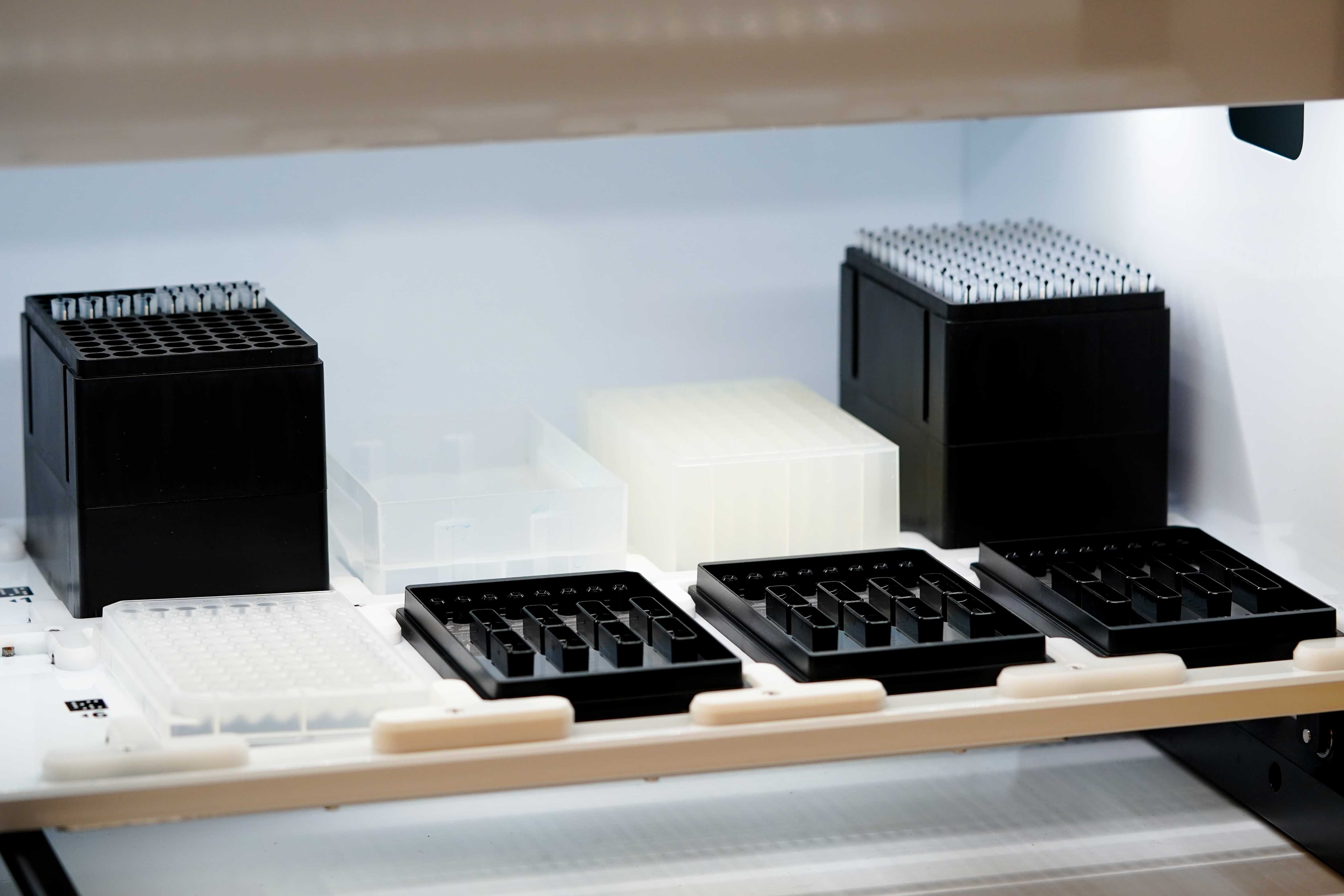
A scalable LNP workflow needs both automation and controlled formulation
LNP formulation can be automated directly on a liquid handler, but different approaches automate different parts of the workflow. Some benchtop systems automate the mixing step alone and leave reagent preparation, collection, and downstream handling to the scientist. Others formulate an entire screen but require manual transfers before downstream characterization.
An automated workflow is therefore worth evaluating on two criteria: how much manual intervention remains as the screen grows, and whether the formulation method produces LNPs consistently enough to compare across a screen.
Automated LNP formulation systems differ in how much of the workflow they cover
Automated LNP formulation systems can be grouped by how much of the surrounding workflow they cover.
| Automation approach | What is automated | What remains separate |
|---|---|---|
| Single formulation benchtop systems | A single formulation is generated under controlled flow conditions | Reagent preparation, sample loading, collection, and downstream handling |
| Multi-formulation benchtop formulation systems | Multiple formulations are generated in a single run | Connection to upstream preparation and downstream processing |
| High-throughput integrated systems | Reagent preparation, formulation, collection, and downstream liquid handling operate within the same workflow | Analytical characterization, and any purification or buffer exchange performed off-deck |
All three approaches reduce manual work. What changes is how often a scientist has to intervene as the number of formulations increases.
For small screens, moving samples between instruments may be manageable. As screens expand across more lipids, molar ratios, and formulation parameters, repeated setup steps, transfers, and instrument handoffs consume more of the time required to complete the screen. The most effective automation removes those repeated steps.
But fewer manual steps do not guarantee better formulation data. A workflow can generate hundreds of formulations without intervention and still produce enough variability in particle size or PDI to make comparisons between formulations less reliable.
That introduces the second requirement for an automated workflow: the formulation step itself has to remain controlled.
Pipette-based mixing scales throughput without controlling LNP formation
Liquid handlers are highly effective at moving precise volumes across many samples, which makes them valuable tools for increasing formulation throughput. The limitation is that precise liquid delivery and controlled mixing are different capabilities.
LNPs form by nanoprecipitation, and self-assembly happens in tens of milliseconds. Mixing has to finish faster than that, and finish everywhere in the sample at once. Otherwise, particles form under different conditions depending on where and when they nucleate, which widens both size and distribution. Fast, complete mixing keeps nanoparticle formation tightly controlled.
Pipette-based mixing occurs by repeatedly aspirating and dispensing the combined lipid and aqueous phases in a single pipette tip. While this simple form of mixing is automation-friendly, it lacks the speed and precision of microfluidic mixing techniques used in dedicated benchtop systems, leading to larger particles and inconsistent populations that confound the screening process.
On-deck microfluidic formulation combines precise mixing with full workflow automation
On-deck microfluidic formulation places a precision microfluidic mixer inside the liquid handler environment, bringing controlled formulation directly into automated workflows.
| Workflow step | What happens |
|---|---|
| Upstream preparation | The liquid handler prepares lipid and aqueous inputs. |
| Formulation | The liquid handler flows the prepared inputs through a microfluidic mixer mounted to the automation deck. |
| Collection | Finished formulations flow into dedicated collection reservoirs. |
| Downstream processing | The liquid handler moves the finished formulation to downstream dilution, plating, and characterization preparation within the same workflow. |
Keeping formulation on deck removes the tedious manual work required to transfer between automated processes on the liquid handler and a standalone formulation instrument. It also gives you control over what happens right after mixing.
Particles are still exposed to ethanol after formulation is complete, where they can continue to grow and aggregate until the ethanol concentration is reduced. Manual handoffs inevitably lead to variable hold times across samples, and that inconsistent timing can cause variation that typically gets blamed on the formulation method.
On deck, every sample waits the same defined interval instead of however long the hand-off happened to take. Across a large screen, that keeps the last formulation on the same schedule as the first.
The LNP Screening Array produces consistent LNPs across liquid handling platforms
The LNP Screening Array brings controlled microfluidic formulation directly onto standard liquid handling platforms, allowing teams to automate reagent delivery, formulation, and collection without moving samples to a separate formulation instrument.
That integration is only useful if the formulation performance remains consistent across the liquid handlers used to run the workflow. The LNP Screening Array produces consistent results across the liquid handling platforms already up and running in your lab:
| Measurement | Result |
|---|---|
| Z-average particle size | 56 to 60 nm across platforms |
| PDI | 0.12 to 0.14 across platforms |
| Platforms tested | Tecan Fluent, Dynamic Devices Lynx VVP, Opentrons Flex, Formulatrix FLO i8 PD, Hamilton STAR |
Evaluate automated LNP formulation in your own workflow
The best way to evaluate an automated LNP workflow is to test it on the liquid handler and with your own formulations.the formulations you intend to use.