Sign in
Home
LNP Screening Array vs. Cytiva NanoAssemblr
By Joshua Gomes
NanoAssemblr Spark and Ignite formulate LNPs one run at a time on dedicated benchtop instruments. The LNP Screening Array runs directly on a liquid handler, generating 100+ formulations per hour while automating input delivery, formulation, and sample collection across the screen.
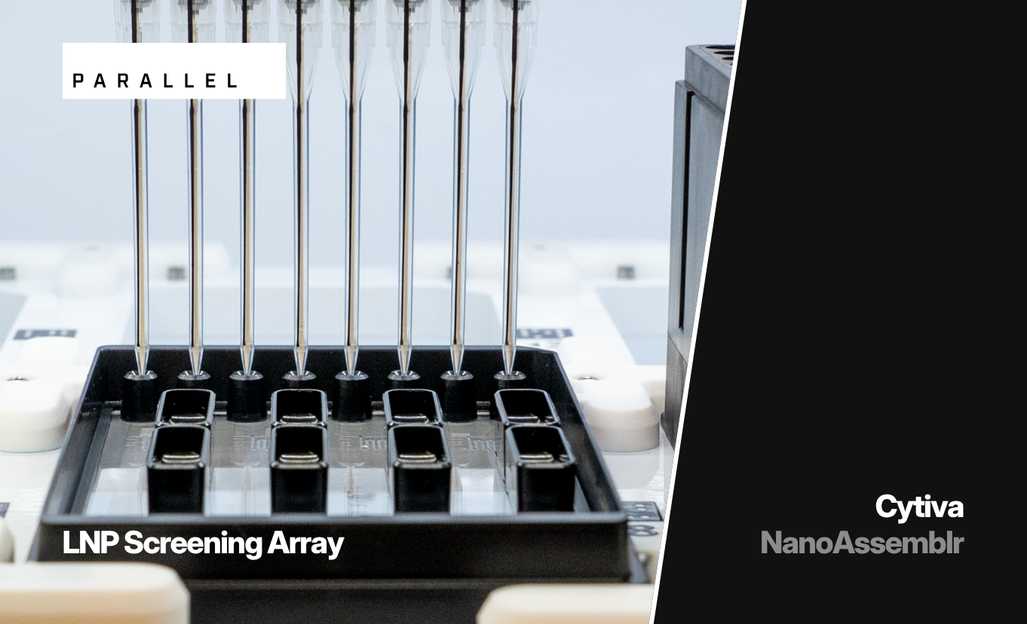
LNP Screening Array vs NanoAssemblr Spark + Ignite
NanoAssemblr Spark and Ignite automate microfluidic mixing, but each formulation remains an individual instrument run with its own input setup and sample recovery.
The LNP Screening Array is built around multi-condition screening: eight independent micromixers sit in an SLAS-format consumable, the liquid handler delivers and collects each sample, and multiple formulations run in parallel within the automated method.
| Comparison | LNP Screening Array | NanoAssemblr |
|---|---|---|
| Platform | Runs on a liquid handler | Dedicated benchtop instruments |
| Formulation sequence | Multiple formulations generated in parallel | 1 formulation per instrument run |
| Formulation paths | 8 independent micromixers per array | 1 microfluidic cartridge per run |
| Input handling | Dispensed from source labware by the liquid handler | Spark - Reagents manually pipetted into the cartridge Ignite - Prefilled syringes loaded into the instrument by the operator |
| Sample recovery | Collected in dedicated reservoirs on deck by the liquid handler | Spark - Sample manually pipetted from the cartridge Ignite - Collection tube retrieved after the run by the operator |
| Screening throughput | 100+ formulations per hour | Spark - 20-30 formulations per hour Ignite - 10 formulations per hour |
Scale across conditions in parallel
Screening time depends on the full cycle behind each formulation, including input loading and sample recovery, and that cycle compounds as the number of conditions grows.
Each NanoAssemblr condition becomes another instrument run that repeats cartridge or syringe prep and sample collection by hand. The LNP Screening Array distributes conditions across eight independent micromixers and can expand across additional LNP Screening Arrays within the same liquid handler method.
| As the screen grows | LNP Screening Array | NanoAssemblr |
|---|---|---|
| 1 formulation condition | 1 of 8 micromixers | 1 instrument run |
| 8 formulation conditions | 1 LNP Screening Array | 8 individual formulation runs |
| 24 formulation conditions | 3 LNP Screening Arrays | 24 individual formulation runs |
| How capacity expands | Add arrays across available deck positions for every 8 formulations | Add individual formulation runs |
| Operator starts between formulations | Not needed | Each formulation is configured and started as its own run, with input loading and sample recovery by hand |
Automate the work around formulation
Spark and Ignite add dedicated formulation instruments to the lab.
The LNP Screening Array instead occupies a standard liquid-handler deck position and uses a configured protocol for the automation already handling the screening workflow.
For teams with supported liquid handlers, microfluidic formulation becomes another capability of that platform rather than another standalone workstation.
| Pre-run workflow | LNP Screening Array | NanoAssemblr |
|---|---|---|
| Prepare formulation inputs | Load source labware for the automated method | Spark - Manually pipette inputs into cartridge Ignite - Prepare prefilled syringes |
| Load formulation hardware | Array loaded once for the programmed screen | Spark - Cap and insert cartridge Ignite - Insert cartridge and load syringes |
| Prepare collection | Handled on deck | Spark - Built into the cartridge outlet well Ignite - Load collection tubes |
| Start each formulation | Not needed | Configure and start each run on the instrument screen |
| Recover each sample | Liquid handler collects sample from output reservoir | Manually pipette each sample out of its collection vessel |
| Repeat for next condition | Method continues automatically | Repeat preparation, run, and collection workflow |
Add screening capacity without another benchtop system
Spark and Ignite add dedicated formulation hardware to the lab.
The LNP Screening Array instead occupies a standard liquid-handler deck position and uses a configured protocol for the automation already handling the screening workflow.
For teams with supported liquid handlers, microfluidic formulation becomes another capability of that platform rather than another standalone workstation.
Spark requires the cartridge to be filled, capped, inserted, started, and emptied. Ignite requires the cartridge, prefilled syringes, and collection tubes to be loaded before the formulation is started and the sample collected afterward.
With the LNP Screening Array, those recurring formulation tasks are incorporated into the liquid-handler method.
| What your lab needs | LNP Screening Array | NanoAssemblr |
|---|---|---|
| Dedicated benchtop formulation system | Not needed | Required |
| Formulation footprint | Standard SLAS deck position on existing liquid handler | Spark -16.5 × 19.5 × 22.5 cm Ignite - 38 × 34 × 38 cm |
| Formulation control | Pre-configured liquid handler method | Spark - Numbered pressure Settings on the instrument screen Ignite - Saved recipe or touch-screen workflow |
| Workflow setup | Liquid handler + LNP Screening Array labware | Spark - Instrument + Spark cartridges Ignite - Instrument + NxGen cartridges + syringes + collection tubes |
Evaluate the LNP Screening Array in Your Lab
Evaluations run in your lab on your own liquid handler with your lipids and cargo, and you set the success criteria against your current method.
We provide the LNP Screening Arrays and a configured automation protocol for your liquid handler, and our applications team helps you run the first screen with you.