Sign in
Home
How the LNP Screening Array Works
By Joshua Gomes
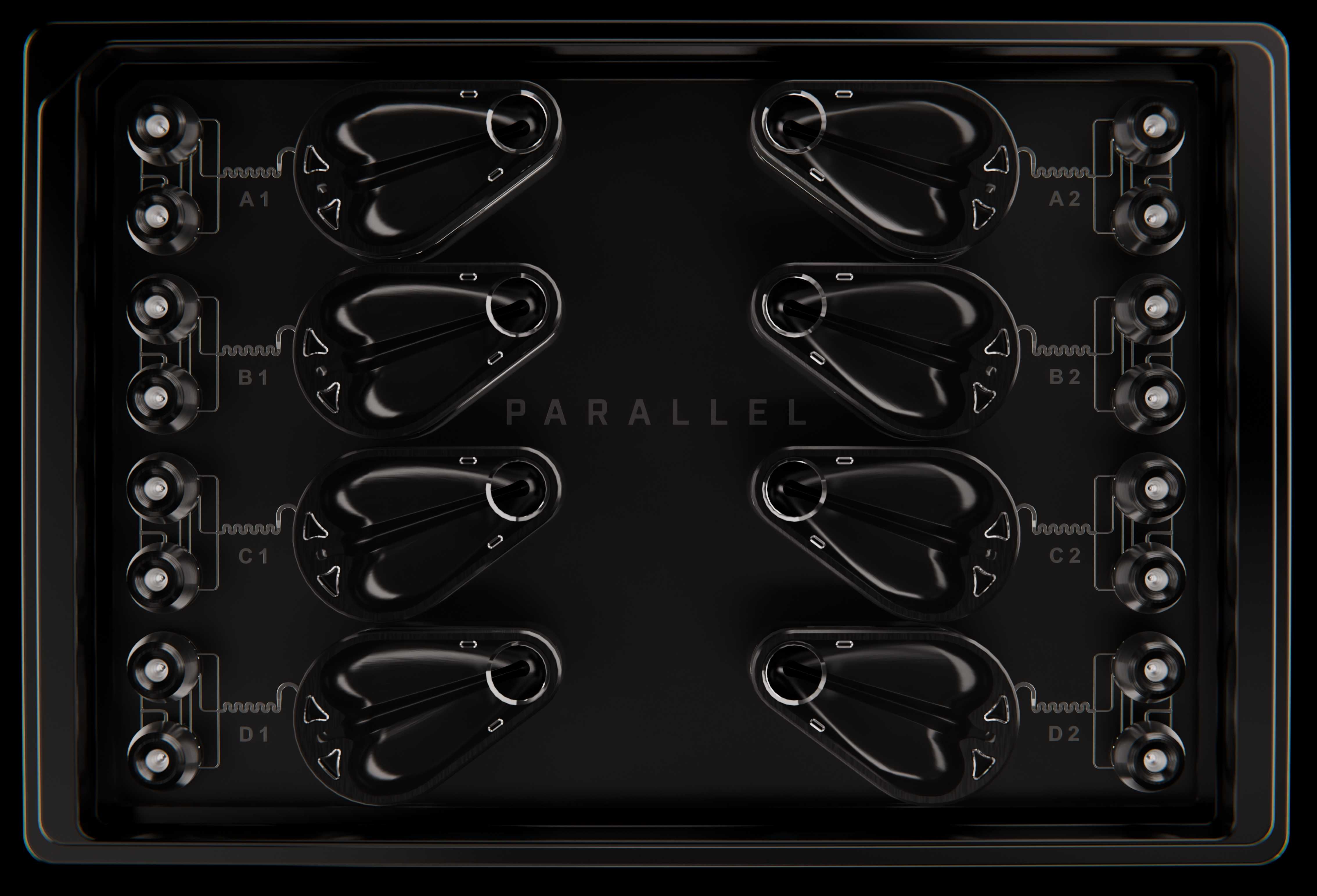
The LNP Screening Array is a microplate-format microfluidic consumable that brings automated lipid nanoparticle (LNP) formulation onto a liquid handler. It combines direct pipette-tip engagement, controlled mixing, and sample recovery in one on-deck device.
For teams already using lab automation, the benefit is straightforward: reagent preparation and LNP formulation can remain in one automated workflow, without external tubing, a separate formulation instrument, or manual transfers before downstream characterization.
LNP Screening Array at a glance
- 8 independent micromixers per array
- 3:1 fluidic resistance ratio
- 100+ formulations per hour
- Less than 50 µL dead volume per formulation
- Characterized on liquid handlers, including Hamilton, Tecan, Formulatrix, Opentrons, and Dynamic Devices
What is the LNP Screening Array?
The LNP Screening Array brings microfluidic LNP formulation directly onto automated liquid handling platforms. Each device contains eight independent micromixers, allowing multiple formulation conditions to run in parallel through the same device architecture.
During a run, the liquid handler dispenses lipid and aqueous phases into the LNP Screening Array. The device routes the two inputs through a defined microfluidic path, brings them together at the junction, mixes them within the micromixer, and collects each formulation in a dedicated output reservoir.
This keeps preparation, formulation, and sample recovery within a continuous plate-based workflow.
For the broader screening strategy behind this workflow, see Building a Higher-Throughput LNP Screening Workflow.
LNP Screening Array components
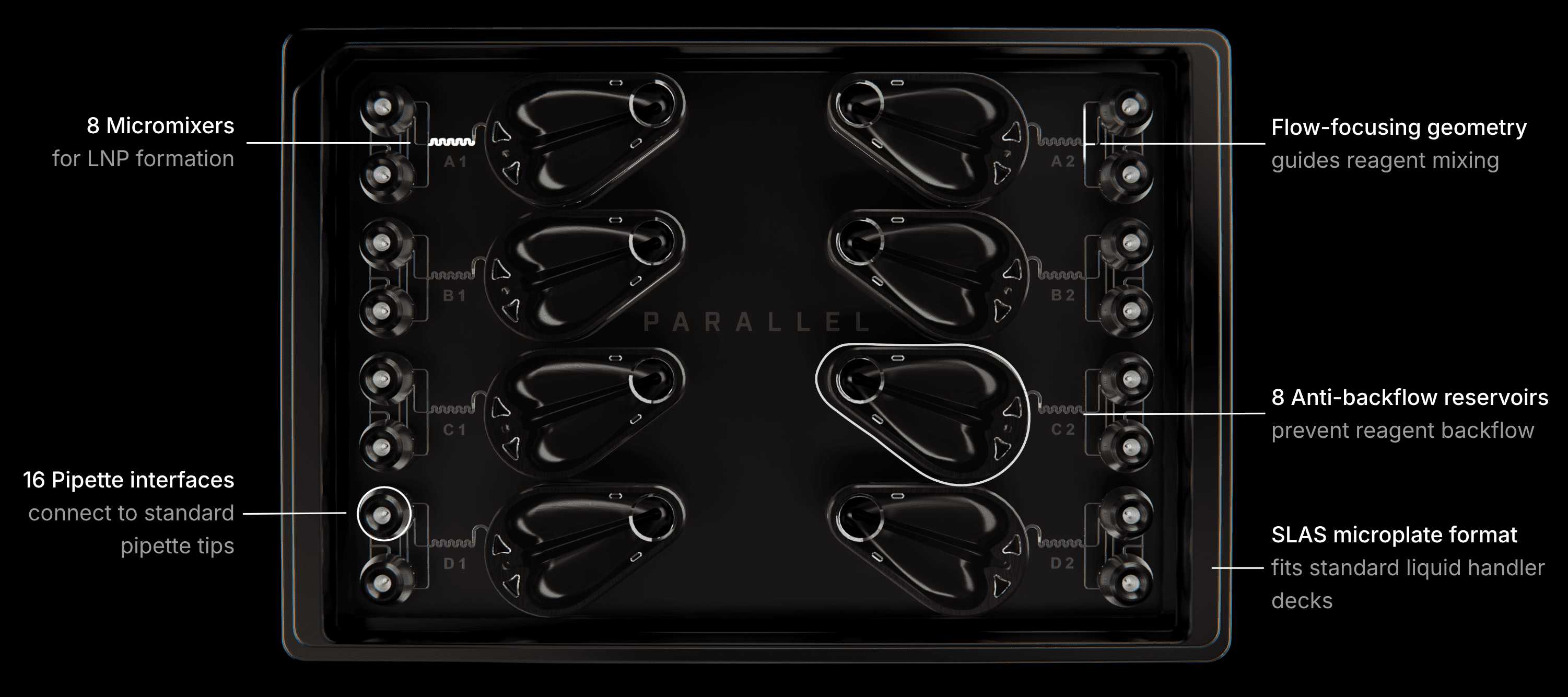
The LNP Screening Array is built around five functional regions that support liquid handler engagement, controlled microfluidic mixing, and sample recovery.
| Component | Function | Why it matters |
|---|---|---|
| Pipette interface | Creates a pressure-tight engagement point between the liquid handler and the LNP Screening Array | Enables direct dispensing into the microfluidic path without custom tubing or off-deck plumbing |
| Input channels | Route lipid and aqueous inputs toward the mixer | Maintain controlled fluid entry into the formulation region at a 3:1 fluidic resistance ratio |
| Junction | Brings lipid and aqueous phases together before mixing | Establishes where LNP formation begins |
| Micromixer | Promotes rapid microfluidic mixing | Supports controlled LNP formation across screening conditions |
| Anti-backflow output reservoir | Collects formulated sample after mixing | Supports cleaner sample recovery while helping isolate collection from the formulation path |
Together, these regions define the full formulation sequence: tip engagement, fluid entry, phase convergence, microfluidic mixing, and sample recovery.
How flow is generated and controlled
The liquid handler provides the positioning, timing, and pressure needed to move the lipid and aqueous phases through the LNP Screening Array. Pressure-tight pipette interfaces connect the liquid handler’s pipette tips directly to the microfluidic channels.
The liquid handler handles liquid delivery, including aspiration, positioning, dispensing, pressure, and timing. The LNP Screening Array handles microfluidic formulation – the defined path through which the lipid and aqueous phases converge, mix, and collect. The automation protocol coordinates the sequence that generates and recovers each formulation.
Flow rate ratio is set by the device, not the protocol. The array's input channels establish a fixed 3:1 fluidic resistance ratio between the aqueous and lipid paths, so the ratio is reproduced by the channel architecture on every run rather than depending on the liquid handler to meter two streams against each other.
The same LNP Screening Array hardware configuration is used across supported platforms. The protocol changes account for how each pipetting technology generates and controls flow.
This allows the LNP Screening Array to run microfluidic formulation without external pumps, custom tubing, or a separate formulation instrument.
How fluids move through the LNP Screening Array
A formulation run follows a defined sequence from preparation through sample recovery.
- Lipid and aqueous inputs are prepared
Inputs are organized according to the screening design. A campaign may evaluate variables such as: lipid composition, cargo, buffer condition, or another variable tied to the screen. - The liquid handler dispenses into the device
Pipette tips engage with the LNP Screening Array and deliver lipid and aqueous phases directly into the microfluidic path. This direct engagement eliminates the need to connect external tubing or transfer prepared samples into a separate formulation instrument. - Input streams converge at the junction
Lipid and aqueous streams travel through separate input channels and meet at a defined junction before entering the mixing region. Keeping the streams separated until this point creates a consistent starting condition for each formulation. - Microfluidic mixing drives particle formation
The micromixer rapidly combines the lipid and aqueous phases, creating the environment required for LNP formation. Each formulation moves through the same micromixer geometry under the flow conditions established by the liquid handler and automation protocol. - Each formulation is collected
Formulated samples move into the dedicated anti-backflow reservoir for direct recovery. The liquid handler can then transfer them into standard plate formats for: particle sizing, PDI measurement, encapsulation efficiency testing, dilution or buffer exchange, stability evaluation, in vitro screening, or other downstream characterization.
The key design point is workflow continuity: the LNP Screening Array keeps dispense, formulation, and recovery inside a device format that liquid handlers can access directly.
How the micromixer supports LNP formation
LNP formation depends on how quickly and consistently the lipid and aqueous phases combine. The LNP Screening Array creates this environment through a defined junction and flow-focusing micromixer geometry.
As the input streams enter the mixing region, microfeatures within the channel induce chaotic advection, rapidly mixing the lipid and aqueous streams to induce nanoparticle self-assembly.
The resulting LNP characteristics can be influenced by:
- Lipid composition
- Cargo type and concentration
- Aqueous and organic phase conditions
- Flow rate ratio
- Total flow rate
- Buffer composition
- Temperature
- Viscosity
- Downstream handling
Flow rate ratio is set by the array's fixed 3:1 flow-focusing geometry rather than by the protocol, so screening campaigns vary the conditions above while the mixing ratio stays constant across every formulation in the run.
The LNP Screening Array does not remove the need to optimize these variables. It gives teams a controlled way to evaluate them across a screening campaign.
Repeating the same device geometry and automation protocol helps teams assess whether changes in particle size, PDI, encapsulation efficiency, or biological performance are associated with the formulation conditions being tested.
Why device consistency matters in LNP screening
Channel geometry and material properties affect how fluids move through a microfluidic device. Variation in channel dimensions, surface condition, or material response can introduce an additional source of variability into a screening workflow.
The LNP Screening Array is manufactured from production-grade thermoplastics selected for solvent compatibility, dimensional stability, and repeatable microfluidic performance. Parallel Fluidics manufactures the array in-house using Transition Molding, which produces microfluidic features with the micron-level accuracy required to support reliable LNP formulation.
Consistent device geometry supports:
- Repeatable fluidic resistance
- Consistent pipette-tip engagement
- Reliable sample collection
- Comparable starting conditions across LNP Screening Arrays
Device consistency does not eliminate formulation variability. Lipid chemistry, cargo, protocol settings, and downstream processing still affect performance. It reduces device-related variability so teams can evaluate formulation and process changes against a consistent hardware architecture.
How the LNP Screening Array fits liquid handling workflows
The LNP Screening Array is designed around standard plate-based automation conventions. Its SLAS microplate-format footprint supports deck placement, while its 96-well-aligned port layout provides direct pipette-tip access to the formulation path.
Pressure-tight pipette interfaces connect the liquid handler to the microfluidic channels without external tubing or custom fluidic plumbing.
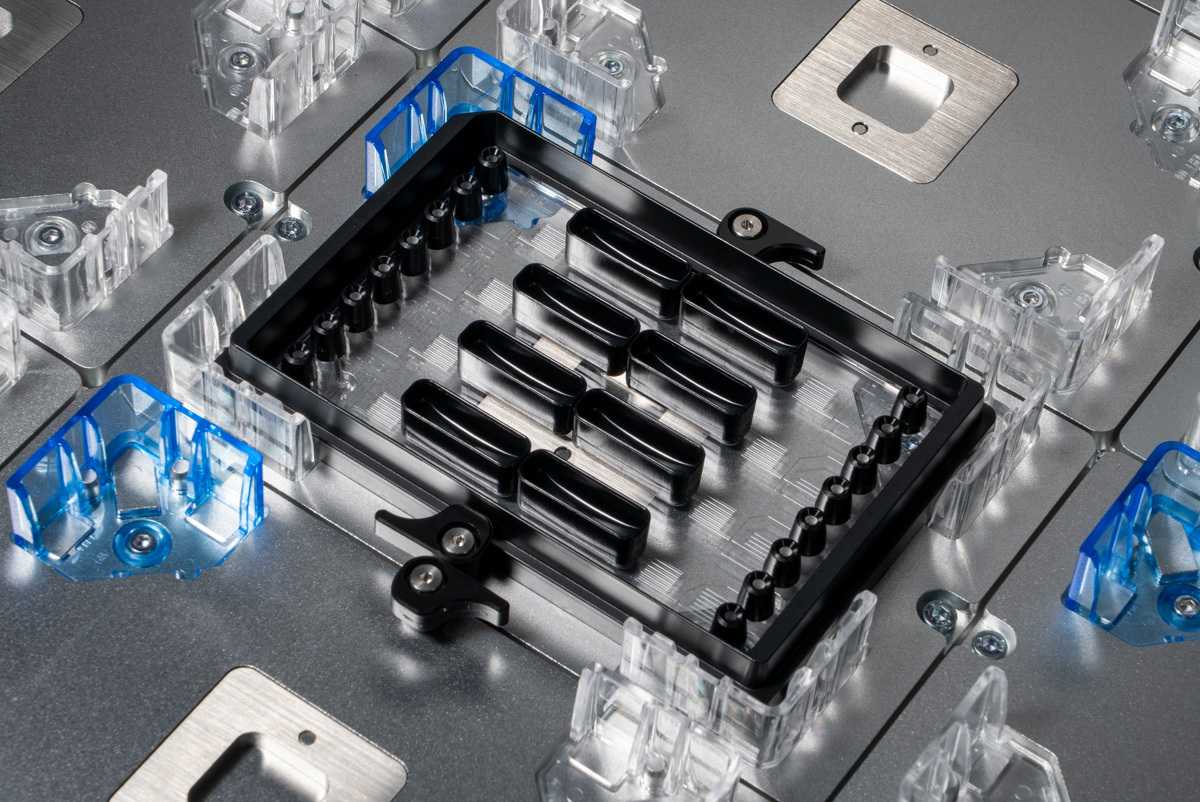
The workflow has been configured and characterized on liquid handlers from:
- Hamilton
- Tecan
- Formulatrix
- Opentrons
- Dynamic Devices
The same hardware configuration is used across platforms. Platform-specific automation protocols account for differences in air-displacement, positive-displacement, and pressure-controlled pipetting.
Compatibility also depends on deck layout, pipetting configuration, and labware setup, which our applications team reviews against your platform before an evaluation.
This allows teams to extend an existing automated workflow into LNP formulation without adding a dedicated formulation instrument or moving samples off deck.
Characterized screening-stage performance
The LNP Screening Array has generated repeatable screening-stage LNPs across characterized liquid handler workflows.
Under defined blank LNP test conditions using an SM-102 lipid mix, the LNP Screening Array achieved:
| Performance measure | Characterized result |
|---|---|
| Z-average diameter | < 60 nm |
| PDI | < 0.15 |
| Z-average variability | < 3% CV |
| Dead volume | < 25 µL per formulation |
These results demonstrate consistent physicochemical performance under the tested conditions.
Performance remains application-dependent. Lipid composition, cargo, concentration, buffer conditions, protocol settings, total flow rate, and downstream processing may affect the resulting particle characteristics.
Teams should evaluate the LNP Screening Array using their intended formulation conditions and downstream readouts.
How to evaluate the LNP Screening Array
The LNP Screening Array Starter Kit gives formulation and automation teams a structured way to evaluate automated microfluidic formulation on their liquid handler.
What is included in the Starter Kit?
The Starter Kit includes:
- LNP Screening Arrays for an initial run
- Platform-specific automation protocol
- Setup components for deck integration and reagent handling
- Application guidance through first results
The Starter Kit supports an evaluation from initial setup through formulation and sample recovery.
What formulation teams can evaluate
Formulation teams can assess:
- Z-average diameter and PDI
- Reproducibility across formulations
- Material use and dead volume
- Sample recovery
- Formulation throughput
- Fit with downstream characterization or biological testing
What automation teams can evaluate
Automation teams can assess:
- Deck placement
- Pipette-tip engagement
- Protocol execution
- Fluid movement and sample collection
- Operator intervention
- Repeatability across runs
The Starter Kit packages the LNP Screening Array with the protocol, setup components, and application guidance needed to move from setup to first-run data.
Once the workflow and performance meet the team’s requirements, the LNP Screening Array and platform-specific protocol can be incorporated into recurring screening campaigns.
Start screening LNPs on your liquid handler
The LNP Screening Array brings microfluidic formulation into the automated workflow already in the lab, allowing teams to screen more LNP conditions without adding a dedicated formulation instrument.
Contact us to discuss your workflow or request an LNP Screening Array Starter Kit to begin testing.