Sign in
Home
Pipette Mixing vs. Microfluidic Mixing for LNP Screening
By Joshua Gomes
Pipette mixing is fast on a liquid handler but produces larger, less consistent LNPs. Microfluidic mixing on the same liquid handler controls particle formation without changing the rest of the workflow.
Compare pipette mixing and microfluidic mixing side by side
Pipette mixing combines the lipid and aqueous phases in a well through repeated aspirate and dispense cycles. Microfluidic mixing brings the two phases together in a channel at a set flow rate and flow rate ratio, so every formulation mixes the same way.
Both methods can run on a liquid handler, so the choice comes down to how fast and evenly each one mixes.
| Consideration | Pipette mixing | Microfluidic mixing |
|---|---|---|
| Where the phases meet | In a plate well | In a microfluidic channel |
| How the phases mix | Repeated aspirate and dispense cycles | Controlled flow through a micromixer |
| Parameters that set the result | Tip type, mixing speed, cycle count, and volume | Flow rate and flow rate ratio |
| Consistency between formulations | Varies with each mixing parameter | Same mixing for every formulation |
Mixing speed sets particle size and uniformity
LNPs begin to self-assemble within milliseconds of the ethanolic lipid phase contacting the aqueous phase. As the ethanol is diluted, the lipids lose solubility and assemble around the nucleic acid cargo. When mixing completes faster than particles assemble, every particle forms in the same environment, producing smaller and more uniform LNPs.
Pipette mixing needs several aspirate and dispense cycles to homogenize the phases, so particles form before the solution is uniform. Regions of the well reach their final composition at different moments, so the particle population spreads across a wider range of sizes and pipette mixing becomes a direct source of variability in LNP formulation.
| Mixing stage | Pipette mixing | Microfluidic mixing |
|---|---|---|
| Where the phases first meet | At the tip opening and in the well | At a defined junction in the micromixer |
| Time to a uniform solution | Several aspirate and dispense cycles | A single pass through the micromixer |
| Environment as particles form | Varies across the well | Uniform for every particle |
| Resulting particles | Larger, with a broader size distribution | Smaller and more uniform |
Pipette mixing produces larger, more variable particles
In a 2026 ACS Nano study, automated pipette mixing produced LNPs of about 180 nm, compared with about 80 nm and more consistent batch-to-batch PDI from microfluidic mixing of the same lipids. A 2025 study on mRNA LNPs found that hand pipetting produced the largest particles of any method tested at a 3:1 flow rate ratio, at about 96 nm, and its authors recommend against pipette-based mixing.
Results also vary with tip type, mixing speed, cycle count, and volume, so each new lipid mix requires re-optimizing the mixing parameters.
| Source | Pipette mixing result | Finding |
|---|---|---|
| ACS Nano, 2026 | About 180 nm with automated pipette mixing | Microfluidic mixing of the same lipids produced about 80 nm LNPs with more consistent batch-to-batch PDI |
| bioRxiv preprint, 2025 | About 96 nm with hand pipetting | Largest particles of any method tested at a 3:1 flow rate ratio, and the authors recommend against pipette-based mixing |
Hits from pipette-mixed screens can change when remade
The mixing method leaves lasting differences in particle size, encapsulation, and in vitro expression. Hits are typically remade with microfluidic mixing for follow-up studies, and their size and activity can shift in the process. A formulation that ranked well in a pipette-mixed screen may not hold its position once it is made with controlled mixing.
Screening with microfluidic mixing from the start keeps the hits you select consistent with the particles you advance.
| Stage | Pipette-mixed screen | Microfluidic-mixed screen |
|---|---|---|
| Screening | Hits selected from pipette-mixed formulations | Hits selected from microfluidic-mixed formulations |
| Follow-up studies | Hits remade with microfluidic mixing | Hits made with the same mixing method |
| Particle properties at follow-up | Size and activity can shift | Consistent with the screening data |
Switch from pipette mixing without changing your workflow
Labs that pipette-mix on a liquid handler already prepare reagents, load tips, and run formulation as a liquid handler method. Microfluidic mixing keeps that method in place and moves the mixing step from plate wells into micromixers on the deck.
The micromixer controls how the phases combine, which removes cycle counts and mixing speeds from method development. Total flow rate is set once in the method, and the micromixer design fixes the flow rate ratio, so a team that runs a liquid handler today can run microfluidic formulation without a microfluidics engineer.
| Workflow step | With pipette mixing | With microfluidic mixing on deck |
|---|---|---|
| Reagent preparation | Liquid handler method | Same liquid handler method |
| Pipette tips | Standard tips | Standard tips |
| Mixing | Aspirate and dispense cycles in a plate well | Dispense through a micromixer |
| Parameters tuned for each lipid mix | Tip type, mixing speed, cycle count, and volume | None, with total flow rate set once in the method |
| Sample collection | Left in the mixing well | Collected in a dedicated reservoir on deck |
Make smaller, more uniform LNPs with the LNP Screening Array
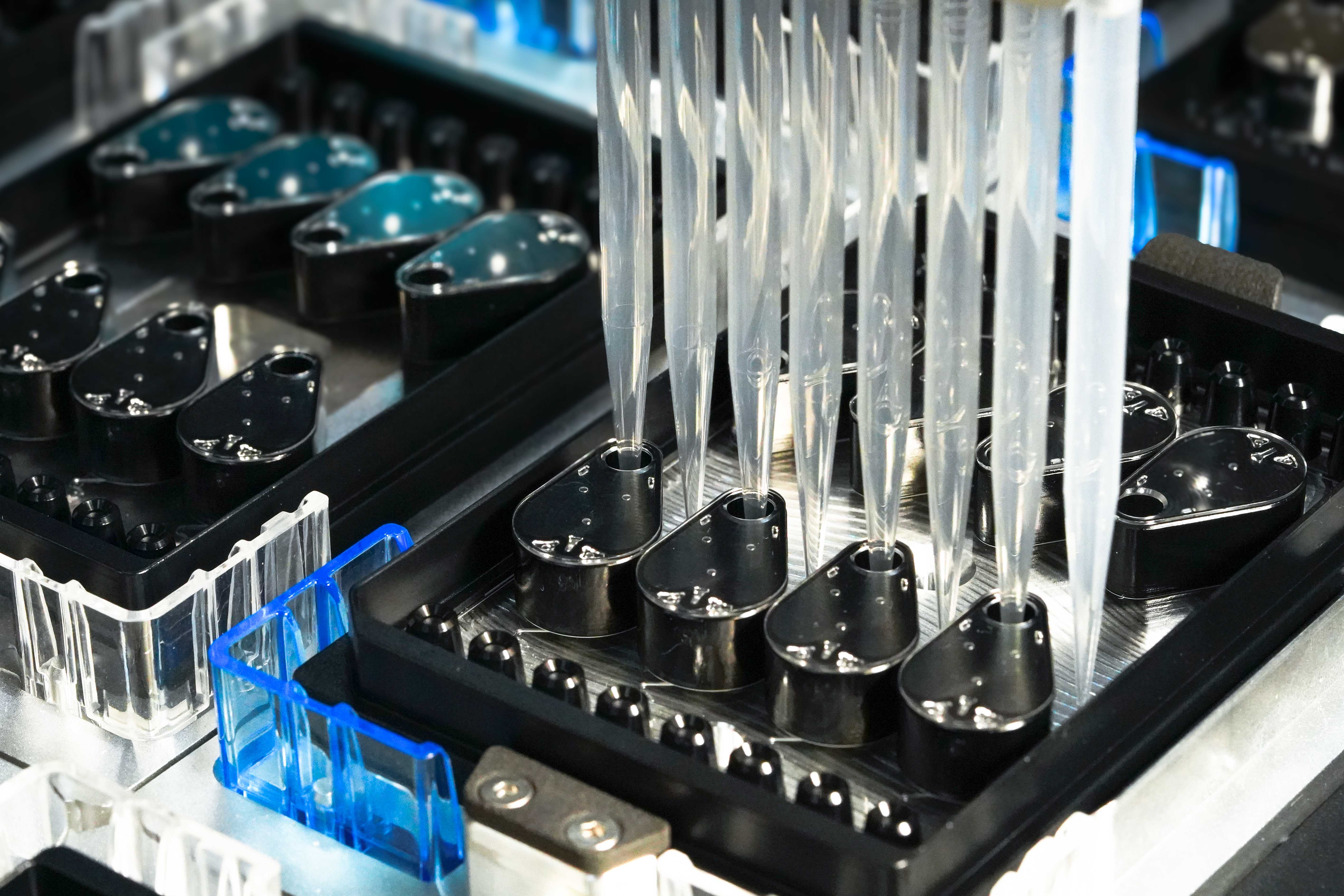
The LNP Screening Array brings microfluidic mixing onto the liquid handler you already use. Every formulation runs through an new, identical micromixer driven by a standard pipette tip, and each LNP Screening Array holds eight micromixers in one standard deck position.
Blank SM-102 LNPs made on the LNP Screening Array measure 56 to 60 nm with PDI of 0.12 to 0.14 across standard liquid handler platforms. Z-average variability below 3% CV keeps mixing from adding noise, so differences across a screen reflect the formulations themselves. How the LNP Screening Array Works walks through the device step by step.
| Pipette mixing limitation | LNP Screening Array result |
|---|---|
| Larger particles | 56 to 60 nm Z-average for blank SM-102 LNPs |
| Broad size distribution | PDI of 0.12 to 0.14 |
| Batch-to-batch variability | Z-average variability below 3% CV |
| Mixing parameters tuned for each lipid mix | New, identical micromixer for every formulation |
Get consistent LNPs from your liquid handler
Walk us through your current pipette mixing method, and we will show you how microfluidic mixing fits into it on your liquid handler.