Sign in
Home
Building a Higher-Throughput LNP Screening Workflow
By Joshua Gomes
A high-throughput LNP screening workflow brings formulation into the same automated environment as sample preparation and analysis, helping teams evaluate more conditions, use limited inputs more efficiently, and compare results with fewer handoffs.
Why LNP screening workflows need to evolve
Lipid nanoparticle (LNP) formulation plays a central role in RNA therapeutics, gene editing, vaccines, and advanced delivery research. As programs evaluate more lipid compositions, cargos, process parameters, and analytical readouts, the value of a screen increasingly depends on how efficiently teams can generate comparable data across a meaningful design space.
Most formulation teams have already automated the work around formulation:
- Liquid handling for input and sample preparation
- Plate-based assay setup
- Downstream characterization and analysis
However, LNP generation is the step that usually hasn't moved. It often still depends on a dedicated formulation instrument, serial processing, and manual transfers between systems.
As the number of conditions increases and formulation materials become more valuable, this disconnected step can begin to limit the scale and design of the screen itself.
What makes LNP screening difficult to scale?
LNP screening depends on controlled comparison across formulation conditions, process parameters, and downstream readouts. Teams need to understand how variables influence particle properties, which formulations merit deeper characterization, and which experimental direction deserves the next round of work.
When particle generation sits outside the automated process, screen design starts to be shaped by execution constraints rather than by the full scientific question. In practice, that shows up as compromises:
- Fewer conditions per campaign than the science calls for
- Reduced replicates
- Follow-up work deferred to a later round
- Scientist time spent coordinating transfers and instrument setup rather than analyzing results
For LNP screening to scale effectively, formulation needs to fit into the way teams already prepare inputs, organize samples, and analyze results.
What a high-throughput LNP screening workflow needs
Increasing the number of formulations alone does not create a better screen. A scalable workflow must preserve the structure, traceability, and consistency required to compare results across a meaningful set of conditions.
A high-throughput LNP screening workflow should support five core capabilities:
| Workflow requirement | Why it matters |
|---|---|
| Structured input preparation | Keeps lipid compositions, cargos, buffers, and process conditions organized and traceable |
| Parallel, repeatable formulation | Reduces serial processing and limits time differences between samples in the same campaign |
| Defined sample recovery | Maintains a clear relationship between each input condition and its formulated output |
| Characterization capacity | Ensures particle sizing, PDI, encapsulation-efficiency, or biological assays can keep pace with formulation |
| A repeatable screening cycle | Allows results from one campaign to directly inform the next set of conditions |
The strongest workflows are designed as complete screening systems rather than treating formulation as an isolated unit operation.
How to structure an LNP screening campaign
Before increasing throughput, teams should define the scientific question, the variables being tested, and the readouts that will determine which formulations move forward.
| Screen component | Examples |
|---|---|
| Formulation variables | Lipid composition, component ratios, cargo, concentration, buffer condition |
| Process variables | Total flow rate, formulation volume, temperature |
| Experimental structure | Controls, replicates, factorial screens, or broader design-of-experiments approaches |
| Physicochemical characterization | Z-average diameter, PDI, concentration, encapsulation efficiency |
| Downstream evaluation | Potency, stability, cellular response, or another application-specific readout |
Defining these elements up front helps teams avoid generating more samples than the downstream workflow can process or collecting data that does not clearly answer the original screening question.
What changes when formulation moves into automation?
Automated microfluidic screening creates a more direct path from input preparation to particle generation. By keeping formulation inside the automated environment, teams can evaluate lipid composition, cargo, flow conditions, buffer conditions, and replicates within one coordinated screening process.
The shift is less about speed than about what stops constraining the screen.
| Formulation outside the automated workflow | Formulation inside the automated workflow | |
|---|---|---|
| Screen design | Shaped by how many conditions the team can physically process | Shaped by the scientific question |
| Sample timing | First and last samples in a campaign differ in age | Conditions generated in parallel, closer in age at characterization |
| Material use | Transfers and instrument hold-up consume limited inputs | Low dead volume keeps more material in the formulation |
| Scientist time | Spent coordinating transfers and instrument setup | Spent on experimental design and interpretation |
| Data comparability | Manual handling adds variability between conditions | Consistent execution across the run |
This is especially useful in early formulation work, where broad exploration is often required before teams narrow toward a smaller set of candidates. Higher throughput, lower material use, and more consistent execution help each screening round produce data that is easier to compare and faster to act on.
The goal is better formulation data with less operational drag.
How the LNP Screening Array changes the workflow
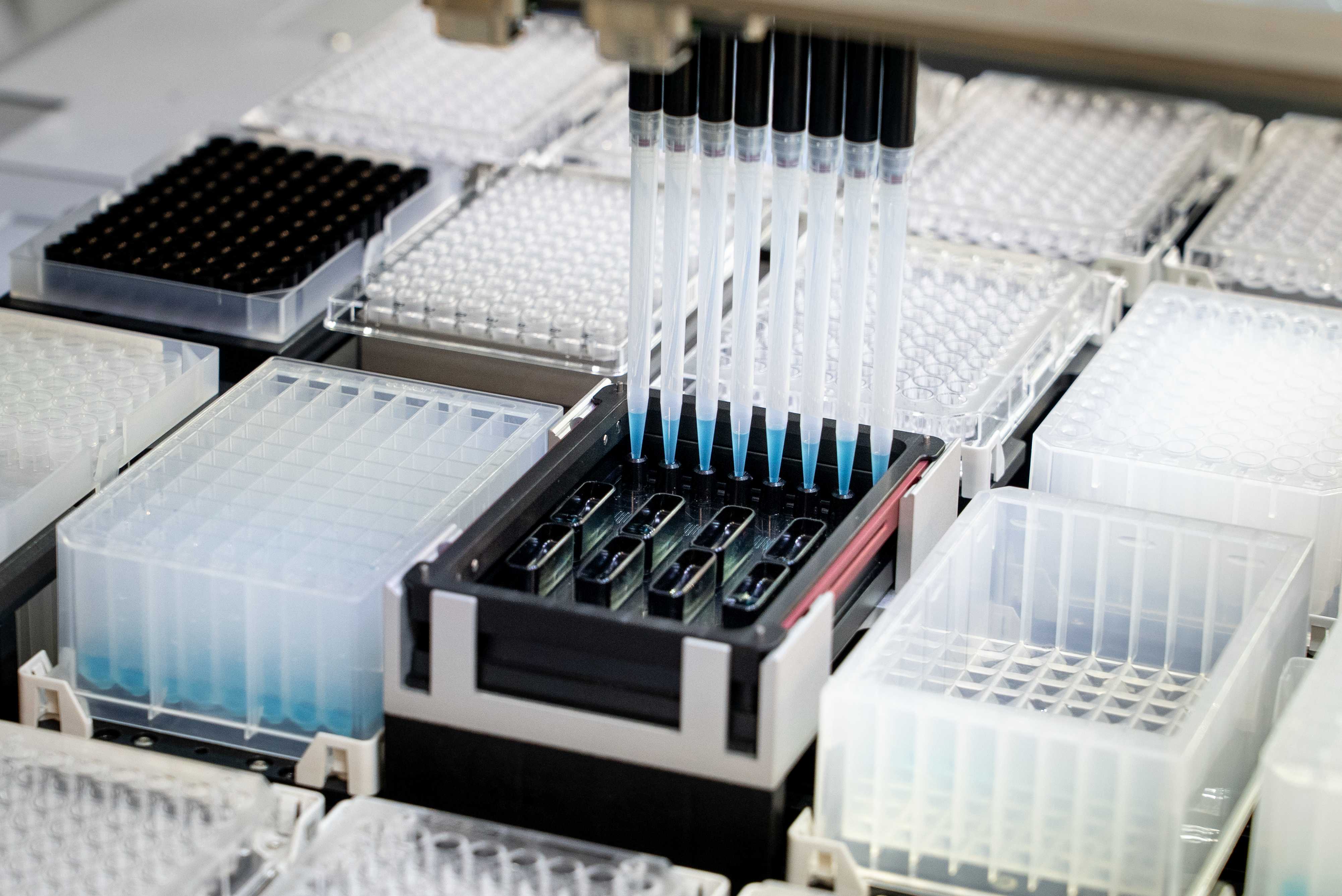
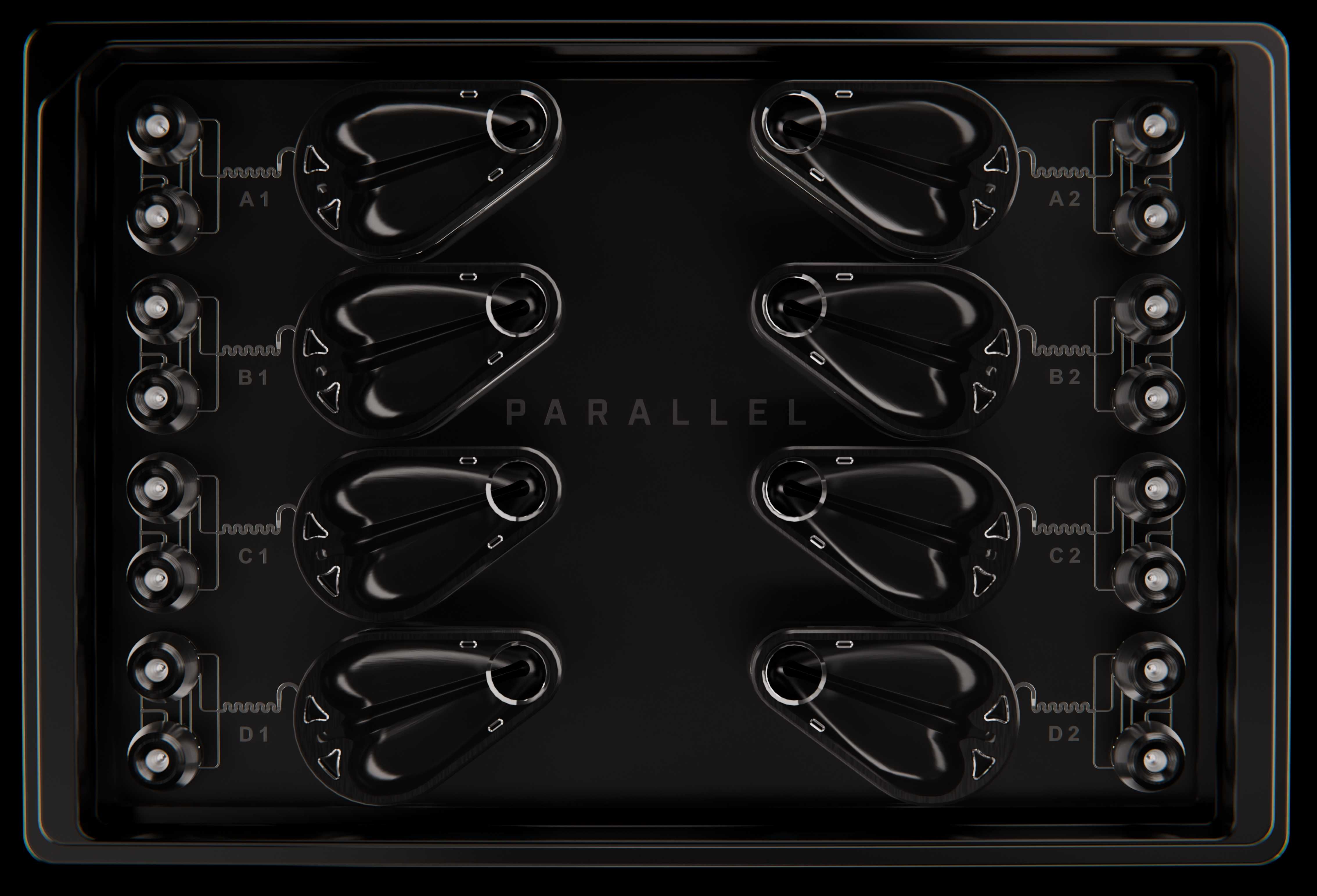
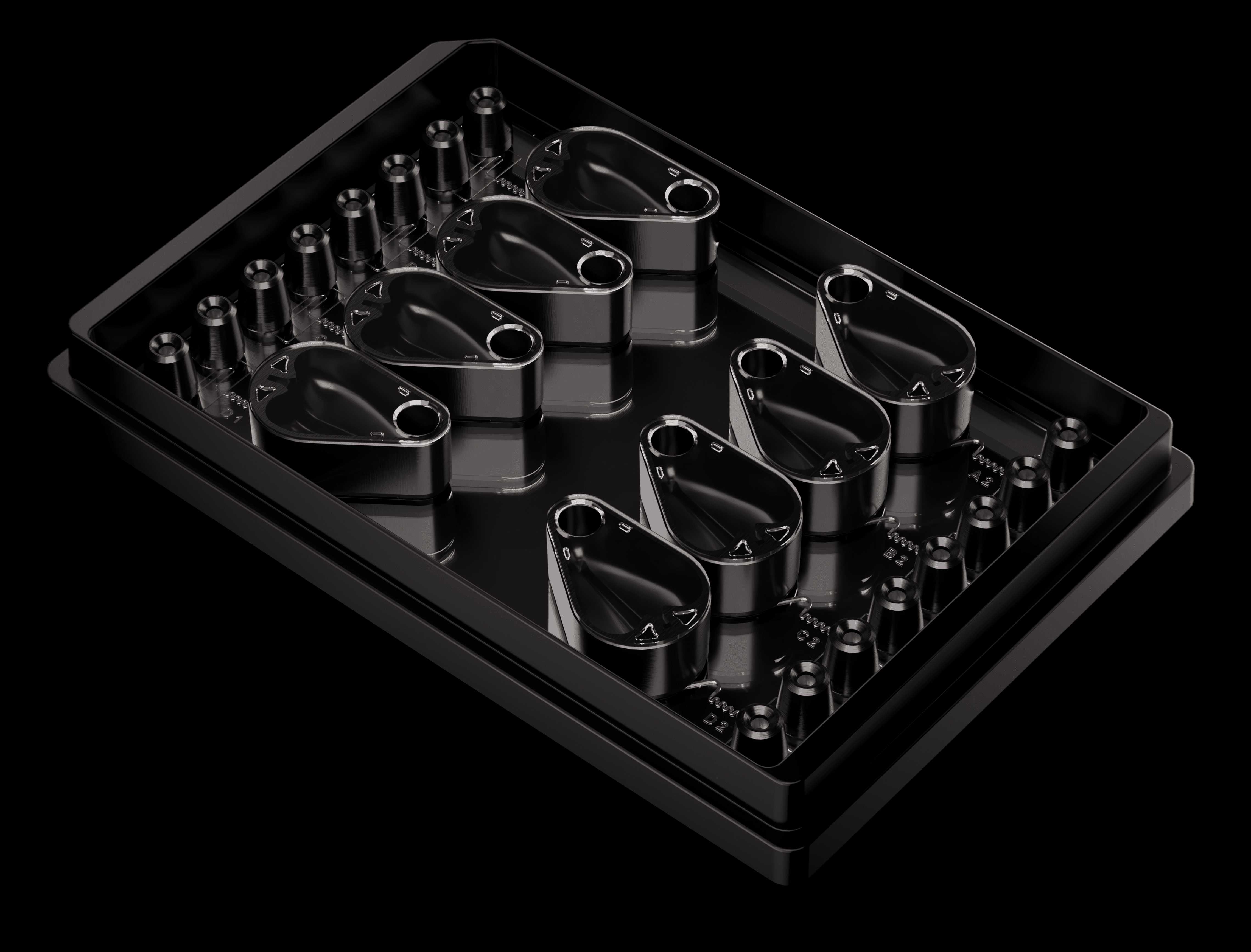
The LNP Screening Array brings microfluidic formulation into one automated liquid handling workflow, allowing teams to generate LNPs on the automation deck instead of routing formulation through a separate dedicated system.
Its role is to connect input preparation, microfluidic formulation, and sample recovery within a plate-based format that the liquid handler can access directly.
| Screening priority | What the LNP Screening Array enables |
|---|---|
| Broader screening capacity | Supports 100+ formulations per hour, helping teams evaluate more conditions per run |
| Faster iteration | Generates each formulation in seconds, shortening the path from screen design to formulation data |
| Lower material burden | Uses low-volume microfluidic formulation with less than 50 µL dead volume per formulation, helping conserve lipid and RNA inputs |
| Workflow continuity | Keeps formulation inside one automated workflow, reducing handoffs between preparation, particle generation, and sample recovery |
| Consistent mixing conditions | Applies the same fixed 3:1 flow-focusing geometry to every formulation, so comparisons across conditions are not confounded by variation in mixing ratio |
| No added instrument | Runs on the liquid handler already on the bench, so screening capacity scales with deck positions rather than capital equipment |
For a closer look at the hardware, components, and liquid handler interface, read How the LNP Screening Array Works.
What this enables for LNP screening teams
- Explore a broader formulation design space
Automated microfluidic formulation gives teams a more practical way to run structured, DoE-style screens across lipid compositions, cargos, and process parameters. Multiple variables and replicates can be evaluated within the same campaign, helping teams identify interactions that may be missed when conditions are tested one at a time. - Generate more data from limited formulation materials
Material availability often shapes what teams can test, especially when RNA cargo is limited or lipid inputs are expensive. With less than 50 µL dead volume per formulation, the LNP Screening Array helps teams preserve more material for additional conditions, replicates, or downstream analysis. - Shorten the cycle from screen design to the next decision
Parallel formulation reduces the time spent processing conditions sequentially and limits the age difference between the first and last samples in a campaign. Reducing repetitive setup, manual transfers, and coordination between instruments also gives scientists more time to interpret results and plan the next screening round. The result is a faster, more repeatable cycle of design, formulation, characterization, and follow-up. - Compare results with less noise from execution
More consistent execution helps teams evaluate formulation outputs with less variability introduced by manual handling, sample movement, or disconnected setup steps. That matters most when the decision about which formulations advance rests on differences in particle size, PDI, encapsulation efficiency, potency, or stability that are small enough to be obscured by handling variation.
From workflow planning to first-run data
Implementing a new formulation workflow requires more than a device and a set of instructions.
Parallel Fluidics works directly with formulation and automation teams to move from initial workflow review through first-run data and recurring screening.
| Stage | Parallel Fluidics support |
|---|---|
| Workflow review | Review the liquid handler, pipetting technology, formulation volume, screening goals, and intended readouts |
| Protocol setup | Provide a starting automation protocol and guidance for deck placement and method setup |
| Initial evaluation | Support first-run execution, troubleshooting, and interpretation of early formulation results |
| Workflow refinement | Review the initial data and adjust protocol or device requirements where needed |
| Recurring screening | Establish the workflow and ordering cadence required for ongoing screening campaigns |
On-site demos and evaluations are also available based on the project and workflow.
A more scalable path for LNP screening
The most effective LNP screening workflows make it easier to structure experiments, preserve limited materials, recover samples, and compare results without adding unnecessary operational complexity.
The LNP Screening Array gives formulation teams a practical way to increase screening capacity while maintaining the workflow control and material efficiency needed for meaningful comparison.
Start building your LNP screening workflow
Ready to evaluate automated microfluidic LNP screening?
Contact us to discuss your workflow or request the LNP Screening Array Starter Kit to begin testing.