Sign in
Home
LNP Screening Array vs. KNAUER NanoScaler
By Joshua Gomes
KNAUER's IJM NanoScaler Pro formulates LNPs one at a time on a dedicated benchtop system of pumps and impingement jet mixers. The LNP Screening Array formulates four at a time on your existing liquid handler using a microfluidic consumable.
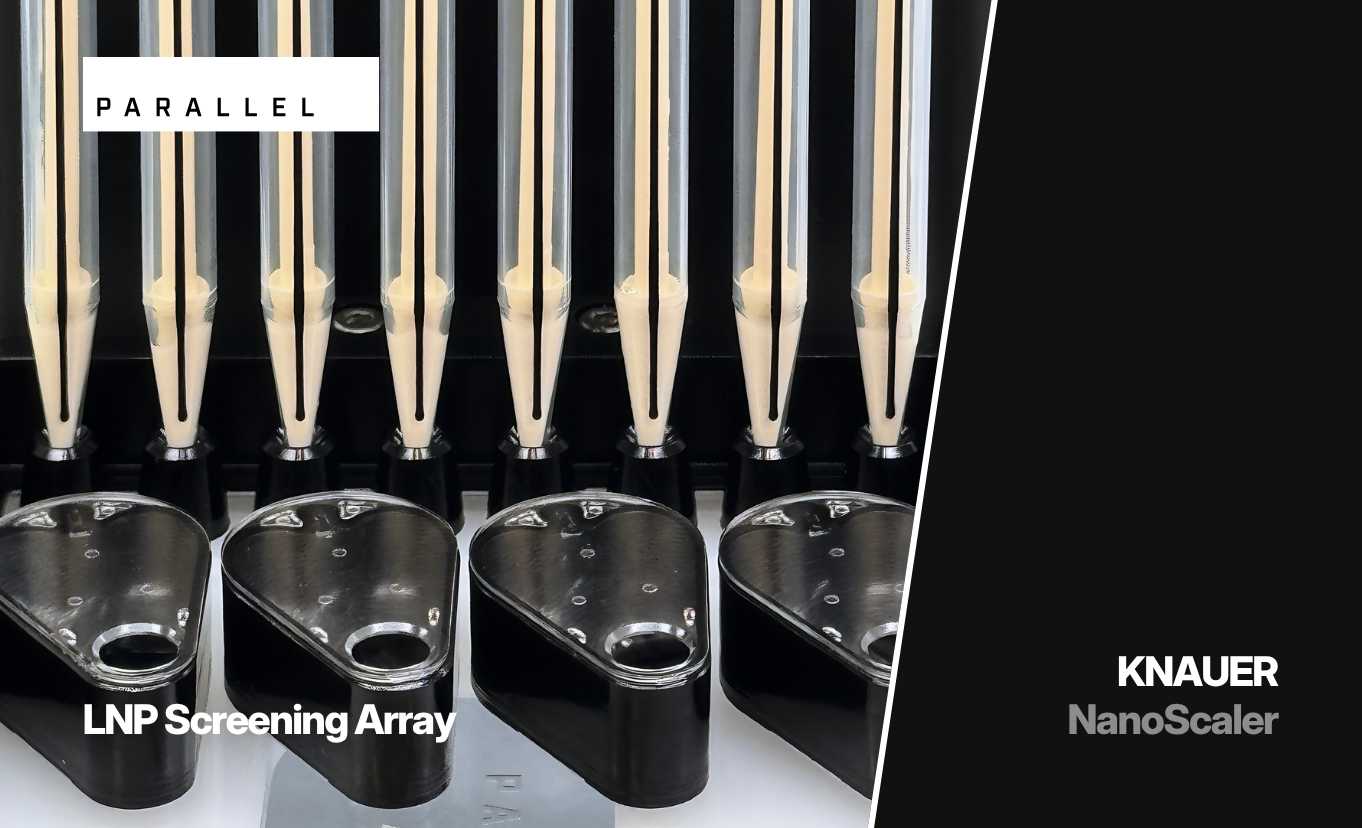
LNP Screening Array vs. NanoScaler Pro
NanoScaler Pro is KNAUER’s automated impingement jet mixing (IJM) system for lipid nanoparticle (LNP) formulation. Two pumps supply the lipid and aqueous cargo streams to the selected mixer, while a third supplies quench buffer downstream of mixing. The system includes five IJMs for different operating ranges and uses an autosampler to process formulations sequentially. A separate fraction-collector module, connected to the formulation system by tubing, dispenses the output into collection tubes.
The LNP Screening Array is a microfluidic consumable for standard liquid handlers. Pipette tips deliver inputs directly into independent micromixers, and each formulation collects in a dedicated reservoir on deck. The comparison below uses the standard, single-autosampler NanoScaler Pro configuration.
| Comparison | LNP Screening Array | NanoScaler Pro |
|---|---|---|
| Formulation platform | Existing compatible liquid handler | Dedicated benchtop instrument |
| Mixing hardware | Independent microfluidic mixers in a single-use consumable | Reusable impingement jet mixer selected for the operating range |
| Simultaneous formulations | Four in parallel | One through the selected mixer |
| Mixer cleaning | Fresh mixer for each formulation; no inter-formulation mixer wash | Reused fluid path with method-specific cleaning requirements |
| Automated input selection | Lipid and cargo selected independently | One input stream varied by the standard autosampler; a second autosampler enables both (system upgrade required) |
| Minimum formulation volume | 100 µL | 300 µL |
| Sample collection | Dedicated reservoirs on the microfluidic consumable | Separate fraction-collector module that dispenses samples into tubes |
The LNP Screening Array’s lower minimum volume is useful when 100 µL provides enough material for the planned sample processing and subsequent assays. Actual lipid and cargo consumption also depends on input concentrations, loading requirements, and sample recovery.
Automate screening without buying a separate formulation instrument
If your lab already uses a standard liquid handler, the LNP Screening Array adds formulation as an on-deck operation. NanoScaler Pro adds a dedicated instrument with pumps, valves, an autosampler, and fraction collection, along with installation, maintenance, and bench-space requirements.
| Equipment requirement | LNP Screening Array | NanoScaler Pro |
|---|---|---|
| Formulation setup | Arrays, deck adapter, and a platform-specific automation method | Dedicated instrument installation and method setup |
| Additional space | One standard SLAS deck position per array, plus supporting labware | Dedicated bench space for the formulation system and supporting instruments |
| Formulation control | Existing liquid handler software | PurityChrom LNP software |
| Equipment upkeep | Uses the liquid handler already maintained by the lab | Adds maintenance for a separate system and its fluid-handling components |
Reusing the liquid handler reduces the equipment required for LNP screening by avoiding acquiring and maintaining another formulation instrument. Deck planning still needs to accommodate source and collection plates, tips, and the number of arrays required for the screen.
Keep reagent prep, formulation, and collection on the liquid handler
With the LNP Screening Array, a configured liquid handler method can prepare working solutions from loaded stocks, formulate LNPs, and recover samples on deck. The method can then continue into dilution and plate preparation for downstream assays.
NanoScaler Pro’s automated lipid premixing combines individual lipid stock solutions into a lipid mixture before formulation. The system also supports inline quench dilution after LNP formation and collects samples in its separate fraction collector module. When reagent preparation or downstream assay preparation runs on a separate liquid handler, materials need to be transferred between the two systems.
| Workflow step | LNP Screening Array | NanoScaler Pro |
|---|---|---|
| Working-solution preparation | Programmed pipetting from loaded stocks on the liquid handler | Automated lipid premixing available within the formulation system |
| Formulation and collection | On-deck micromixers and dedicated collection reservoirs in one consumable | IJM formulation followed by fraction collection |
| Downstream assay preparation | Dilution and plate preparation can continue in the liquid-handler method | Separate assay-preparation workflow after collection with manual transfer to separate instrument |
Keeping samples on deck is useful when screening includes dilution for dynamic light scattering (DLS) and plate preparation for a RiboGreen encapsulation assay. These preparation steps can follow formulation without a transfer from a separate formulation instrument; measurements still take place on the relevant analytical instruments.
Run four formulations at a time
The LNP Screening Array can support a 96-formulation screen on a liquid handler, processing four formulations at a time through independent micromixers. Each formulation uses a fresh mixer, eliminating mixer washing between conditions. Reagent preparation, formulation, and collection stay on the same liquid handler, reducing manual transfers between instruments.
NanoScaler Pro accommodates up to 108 samples per sequence, which its autosampler processes one after another through the selected IJM. Running that sequence requires a dedicated benchtop formulation system and fraction collector, with cleaning of the reused fluid path. Samples destined for assay preparation on a separate liquid handler must then move between systems.
| Formulation operation | LNP Screening Array | NanoScaler Pro |
|---|---|---|
| Sample execution | Four formulations during a parallel dispensing step | Sequential formulations through the selected IJM |
| Mixing path | Independent mixer for each formulation | Shared mixer and connected fluid path |
| Mixer preparation between conditions | Move to an unused mixer | Follow the cleaning requirements of the formulation method |
Independent mixers allow several formulations to share a dispensing step and remove mixer washing from the sequence. Total screen time also depends on reagent preparation, dispensing settings, and downstream processing, so a runtime comparison should cover the complete workflow.
Vary lipid and cargo in the same run
The LNP Screening Array lets the liquid handler select the lipid and cargo for each formulation independently from loaded source plates. A method can therefore work through a matrix of lipid and cargo combinations without holding either input constant throughout the run.
The standard NanoScaler Pro includes one autosampler, which automates changes to one input stream. A second autosampler, available through the NanoScaler Ultra configuration or upgrade, enables automated switching of both streams.
| Input-selection requirement | LNP Screening Array | NanoScaler Pro |
|---|---|---|
| Select inputs across a sequence | Lipid and cargo chosen independently from source plates | One input stream varied automatically while the other remains fixed |
| Automate changes to both inputs | Use the liquid handler’s existing pipetting system | Add a second autosampler through the Ultra configuration or upgrade |
This flexibility is useful when a screen needs to compare the different lipid compositions across multiple cargos. The combinations that fit into one liquid-handler run depend on the loaded materials, deck layout, and available consumables.
Evaluate the LNP Screening Array in your lab
Evaluate the LNP Screening Array on your liquid handler using the lipid and cargo combinations your screen needs. Get applications support to compare sample quality, hands-on time, and complete workflow throughput against your current formulation method.