Sign in
Home
LNP Screening Array vs. Fluigent Liposome Nanoparticle Production Station
By Joshua Gomes
Fluigent’s Liposome Nanoparticle Production Station runs one liposome formulation at a time through pressure controllers and a reusable glass chip, while the LNP Screening Array produces each LNP formulation in seconds on your existing liquid handler.
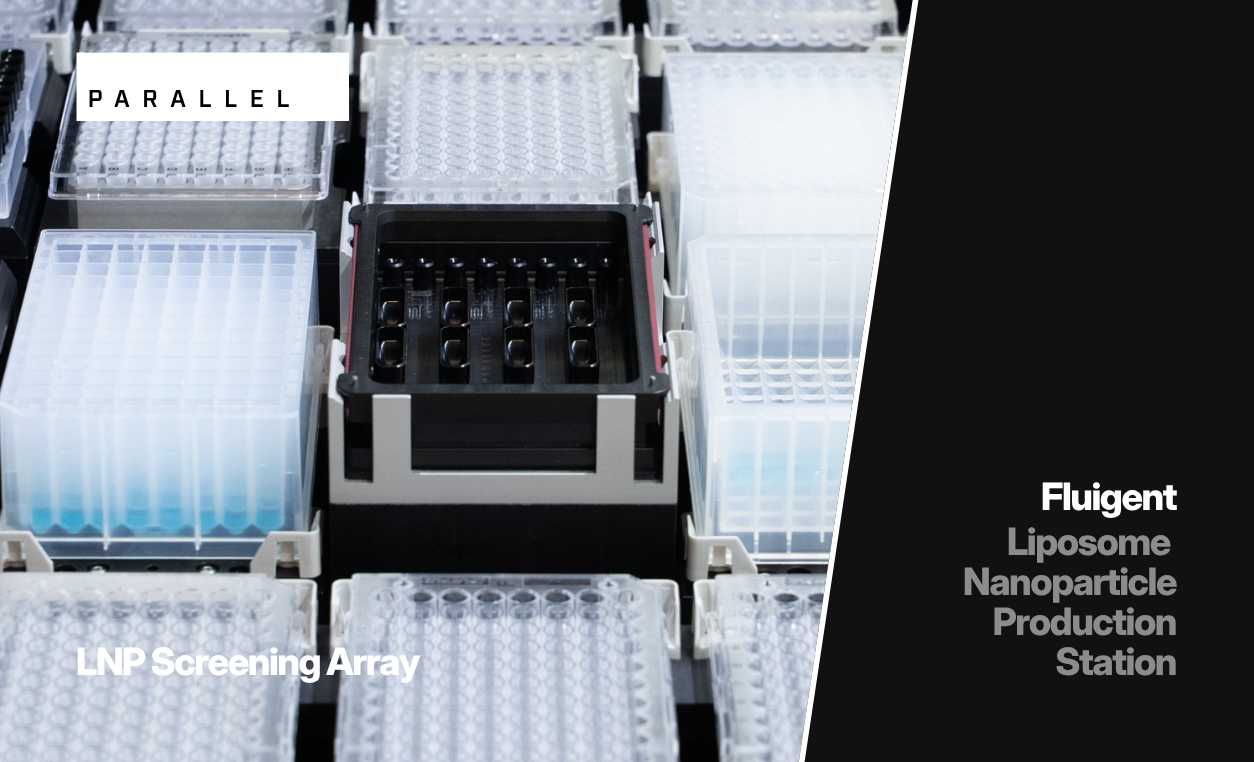
LNP Screening Array vs. Fluigent Liposome Nanoparticle Production Station
Both systems make lipid nanoparticles by microfluidic mixing at a controlled flow rate ratio, but they are built for different jobs. Fluigent sells the station as its Liposome Production Pack, a benchtop setup for continuous liposome production in which two Flow EZ pressure controllers push an ethanol lipid phase and an aqueous phase through one reusable glass herringbone chip, with two flow sensors measuring each stream. The pack makes a single formulation for as long as its reservoirs last.
The LNP Screening Array is built for screening instead. Its eight micromixers sit in one standard deck position, and your existing liquid handler produces each formulation in seconds, reaching 100+ formulations per hour.
| Comparison | LNP Screening Array | Fluigent Liposome Production Pack |
|---|---|---|
| Built for | LNP formulation screening | Continuous liposome production |
| Platform | Existing liquid handler | Benchtop pressure-driven setup |
| Mixers | Eight micromixers per LNP Screening Array | One reusable glass herringbone chip |
| Formulations per hour | 100+ | No published rate |
| Control software | Existing liquid handler software | Fluigent OxyGEN |
Screen a full lipid library in one run
Fluigent describes the pack as a “reliable and complete system for long-term production,” and it ships with 15 mL and 50 mL pressurized reservoirs feeding a single chip, a format built for milliliters of one formulation at a time. A screen asks for the opposite, many distinct formulations in small volumes, each made the same way so the results can be compared. Each new formulation on the pack means swapping the lipid and aqueous reservoirs by hand and purging the previous formulation from the tubing and chip before the run restarts.
On the LNP Screening Array, the liquid handler draws each lipid mix and cargo from reagents on deck and produces each formulation in seconds, so a full lipid library runs at 100+ formulations per hour with no hands-on time between formulations.
| Screening a lipid library | LNP Screening Array | Fluigent Liposome Production Pack |
|---|---|---|
| Formulations per run | Every formulation planned on the deck | One per reservoir change |
| Reagent format | Lipid mixes and cargo loaded on deck | 15 mL and 50 mL pressurized reservoirs |
| Moving to the next formulation | Liquid handler draws the next reagents from the deck | Reservoirs swapped by hand and the previous formulation purged |
| Hands-on time between formulations | None | Required for every formulation |
Screen LNPs on a platform with published LNP data
Fluigent’s documentation for the pack is built on liposomes, with a protocol that makes DDAB liposomes from an ethanol lipid phase and PBS at pH 7.2, and a case study on amiodarone-loaded liposomes.
RNA-LNPs depend on different chemistry, with the RNA in an acidic aqueous buffer, usually around pH 4, so the ionizable lipid takes on a positive charge and binds the RNA as the particles assemble. A protocol built on a neutral buffer and a permanently charged lipid such as DDAB leaves the LNP method for the lab to develop.
The LNP Screening Array has published characterization data for LNPs made with SM-102, the ionizable lipid in an approved mRNA vaccine. Blank SM-102 LNPs measure 56 to 60 nm with PDI of 0.12 to 0.14 and Z-average variability below 3% CV across standard liquid handler platforms.
| Evidence | LNP Screening Array | Fluigent Liposome Production Pack |
|---|---|---|
| Documented formulations | SM-102 LNPs | DDAB liposomes |
| PDI | 0.12 to 0.14 | Up to 0.2 |
| Batch-to-batch variability | Z-average variability below 3% CV | No published figure |
| Where the LNP data comes from | The LNP Screening Array | A research group’s own platform built around Fluigent controllers |
Start with a protocol configured for your liquid handler
Fluigent supplies a liposome protocol and user guide, and the lab assembles the pack’s two pressure controllers, control module, two flow sensors, pressurized reservoirs, tubing, and glass chip. The Flow EZ controllers also need an external supply of dry, oil-free gas at 7.1 bar, and the lab sets pressures and flow rates in OxyGEN before the first formulation.
We configure the automation protocol for your liquid handler and install it in your lab. Our applications team supports your first run on site, and technical support continues afterward.
| Getting started | LNP Screening Array | Fluigent Liposome Production Pack |
|---|---|---|
| Protocol | Configured for your liquid handler and pipetting technology | Liposome protocol and user guide |
| Assembly | None | Controllers, control module, sensors, reservoirs, tubing, and chip assembled by the lab |
| Pressure supply | None | Dry, oil-free gas at 7.1 bar |
| Installation | Installed in your lab by our team | Set up by the lab from the user guide |
| First run | Supported on site by our applications team | Run by the lab from the user guide |
Control flow with your liquid handler and the LNP Screening Array
Fluigent regulates each phase with its own pressure controller and flow sensor, connected to the chip by tubing, and adjusts particle size by changing the flow rate ratio in OxyGEN.
On the LNP Screening Array, the liquid handler drives each formulation through a pressure-tight pipette interface, so controlled flow comes without pressure controllers, flow sensors, or pressurized reservoirs. Each micromixer’s fluidic resistance ratio fixes the flow rate ratio at 3:1, and the automation protocol sets total flow rate, so there is nothing to tune between formulations. Does Microfluidic LNP Formulation Require a Pressure Controller? explains how a liquid handler supplies controlled flow.
| Flow control | LNP Screening Array | Fluigent Liposome Production Pack |
|---|---|---|
| Flow source | Liquid handler | Two Flow EZ pressure controllers |
| Flow measurement | Not needed | Two flow sensors in the fluid path |
| Flow rate ratio | Fixed at 3:1 by each micromixer | Set and adjusted by the lab in OxyGEN |
| Total flow rate | Set in the automation protocol | Set and adjusted by the lab in OxyGEN |
| Connection to the mixer | Pipette tip sealed to the pipette interface | Tubing and fittings |
Make each LNP formulation in seconds on your liquid handler
Talk with our team about the formulations you need to screen and the liquid handler you run today.