Sign in
Home
What Is LNP Formulation Screening?
By Joshua Gomes
LNP formulation screening involves testing many small-volume lipid nanoparticle formulations side by side to find the composition or cargo that performs best. How a team makes those formulations sets how many it can screen and how reliably it can compare the results.
Screen many formulations to find the few LNPs worth advancing
A lipid nanoparticle (LNP) carries nucleic acid cargo, such as mRNA or siRNA, inside a particle built from four lipids. An ionizable lipid binds the cargo during mixing and helps release it inside the cell, while a helper lipid, cholesterol, and a PEG-lipid give the particle its structure and stability.
Small changes to any of these components can shift particle size, cargo loading, and delivery in ways that are hard to predict, so teams make many candidate formulations and test them side by side. Each screen answers one of two questions, depending on whether the carrier or the cargo is under study.
| Screening goal | Question it answers | What stays fixed |
|---|---|---|
| Optimize the delivery vehicle | Which lipid composition delivers this cargo best? | Cargo |
| Evaluate the cargo | Which cargo produces the strongest response in this formulation? | LNP formulation |
Both types of screens end in a shortlist of formulations backed by enough data to justify further testing.
Vary the lipids, ratios, and cargo that shape each particle
A screen's design space is the set of components a team changes from one formulation to the next. Many screens change one or two components at a time and hold the rest steady, so a difference in results can be traced to a specific change. Design-of-experiments (DoE) screens vary several components together to map how they interact.
| Variable | What teams change | Why it matters |
|---|---|---|
| Ionizable or cationic lipid | Lipid identity, often drawn from a library of candidates | Drives encapsulation and endosomal release |
| Lipid ratios | Molar ratios of ionizable or cationic lipid, helper lipid, cholesterol, and PEG-lipid | Shapes particle size, stability, and delivery |
| N/P ratio | Ratio of ionizable or cationic lipid amines to cargo phosphates | Affects encapsulation and potency |
| Cargo | Nucleic acid type, sequence, and concentration | Sets the therapeutic response and influences how particles assemble |
| Buffer | Aqueous buffer composition and pH | Sets the pH at mixing, which controls the charge of ionizable lipids |
The mixing method needs to stay constant as well, because when mixing changes between formulations, differences in the particles can reflect how each sample was made instead of what it contains.
Run a screen from design to shortlist
A screen runs in rounds, and each round moves through the same stages, from choosing what to make to choosing what advances.
| Stage | What happens | What it produces |
|---|---|---|
| Design | The team chooses which formulations and replicates to make | A plate map for the round |
| Input prep | Lipid stocks and cargo are prepared | Inputs ready to formulate |
| Formulation | The lipid and aqueous phases mix and the particles self-assemble | Formulated LNPs |
| Processing | Samples are diluted, buffer exchanged, and/or concentrated | Samples ready to measure |
| Characterization | Particle properties are measured for each formulation | Physicochemical data |
| In vitro testing | Cells are dosed with the leading formulations | Biological activity data |
| Selection | Results are compared across the round | A shortlist and the design for the next round |
The shortlist feeds the design of the next round, so the time one pass takes decides how many rounds fit in a program. Formulation often runs on a separate instrument between two liquid handler steps, which makes it the step where time and manual handling add up fastest.
Measure the properties that decide which formulations advance
Each measurement in a screen answers a specific question about the formulation. Size, PDI, and encapsulation efficiency are typically measured on every formulation, while structural methods and cell-based assays are usually reserved for the formulations that pass because they take more time and material.
| Readout | What it tells you | Typical method |
|---|---|---|
| Z-average diameter | Average particle size | Dynamic light scattering (DLS) |
| Polydispersity index (PDI) | How uniform the particle sizes are | DLS |
| Encapsulation efficiency | How much of the cargo is loaded inside the particles | RiboGreen fluorescence assay for RNA cargo |
| Zeta potential | Surface charge of the particles | Electrophoretic light scattering, often on the same instrument as DLS |
| Morphology and internal structure | Particle shape and how lipids and cargo are organized inside | Small-angle X-ray scattering (SAXS) or multi-angle light scattering (MALS) |
| In vitro expression | Whether the particles deliver functional cargo into cells | Cell-based assays |
| Cell viability | Whether cells tolerate the formulation | Cell-based assays |
| In vivo delivery | Whether the formulation reaches target tissue and expresses its cargo | Expression or biodistribution study in animal models, often on a small early set |
A promising result earns a repeat preparation before it advances, because a single formulation can't show whether the result reproduces.
Choose a formulation method that keeps results comparable
Everything a screen compares depends on the formulation step. Size and PDI can only separate candidates when mixing is fast and identical for every formulation, and a round only moves quickly when formulation runs without manual steps between input prep and processing.
The table below compares common formulation methods on how well each one controls the particles and how much setup and hands-on work it adds to every formulation.
| Comparison | Pipette mixing | Benchtop instrument | On-deck microfluidic formulation |
|---|---|---|---|
| Where formulation happens | In plate wells by repeated aspirating and dispensing | On a separate benchtop system | On your liquid handler deck |
| Particle control | Slow mixing produces larger particles with broader size distributions | Controlled, in the instrument's microfluidic mixer | Controlled, with the same mixer design for every formulation |
| Method setup | Tip choice, mixing speed, and cycles re-optimized for each new lipid mix | Flow settings entered in the instrument's software for each run | Pre-configured protocol |
| Between formulations | New tips and another round of mixing cycles | Mixer flushed or cartridge swapped by hand | The liquid handler moves to the next mixer |
| Moving samples to processing | Samples stay in the mixing plate | Samples carried by hand from the instrument | Samples collected on deck and processed in the same run |
Pipette mixing is the easiest to start but gives up particle control, and a benchtop instrument controls the particles but adds manual loading and recovery to every formulation. On-deck microfluidic formulation controls the particles with no manual steps between formulations, so every sample is made the same way and moves straight into processing.
Screen LNP formulations with the LNP Screening Array
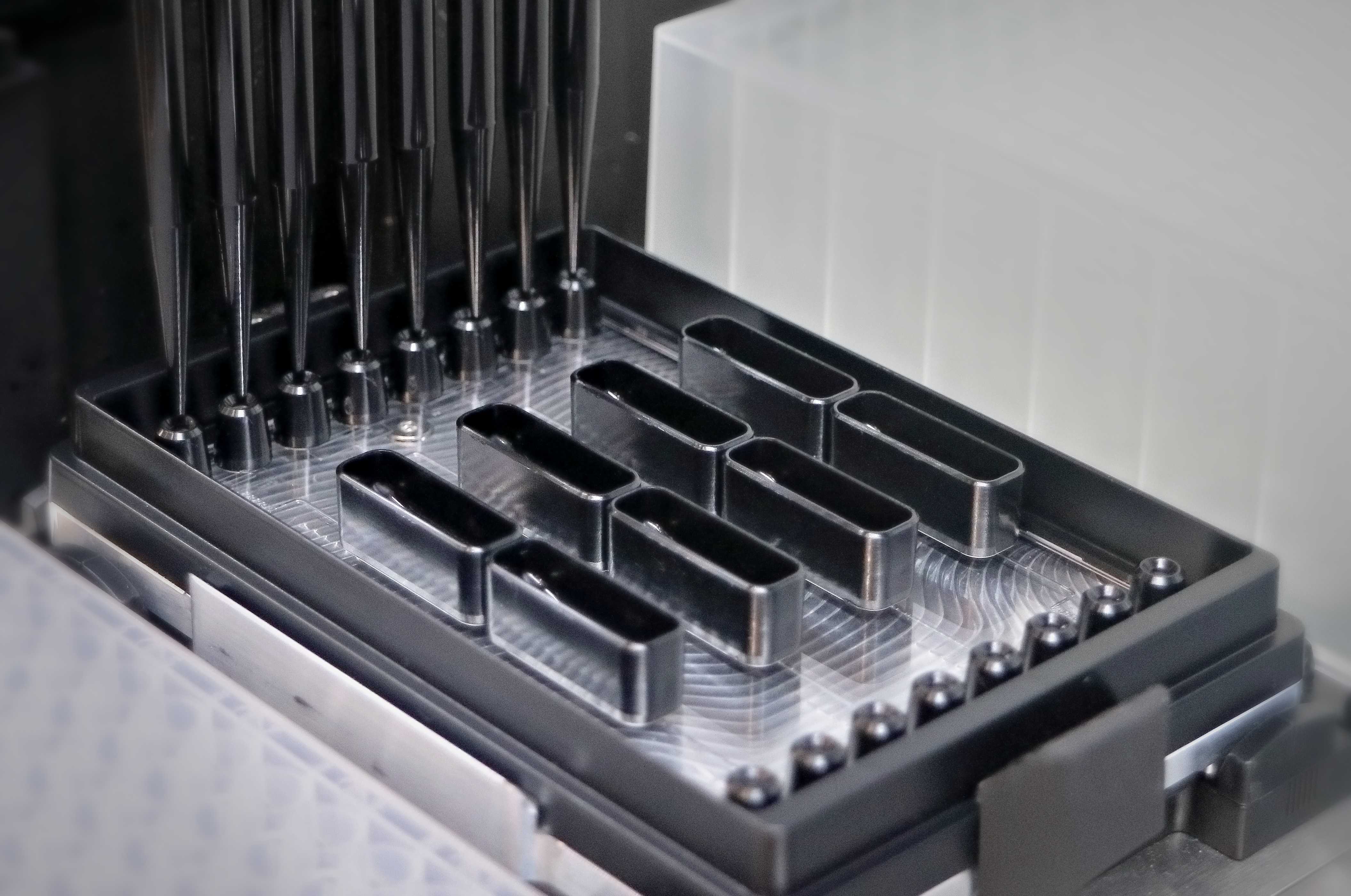
The LNP Screening Array brings microfluidic formulation onto your liquid handler. Each formulation is generated in seconds and collected on deck, ready for processing in the same method.
| Screening need | How the LNP Screening Array meets it |
|---|---|
| Consistent mixing | Same mixer design for every formulation |
| Fast formulation | Each formulation generated in seconds |
| Automated handling | Inputs dispensed and samples collected on deck |
| Fit with existing automation | Runs on standard liquid handlers |
For a step-by-step view of the process, see How the LNP Screening Array Works.
Evaluate the LNP Screening Array in your lab
Evaluations run in your lab with your own lipids and cargo. Our applications team helps you with the first run and runs DLS with you during the visit.